
Almost everything you do online is protected by encryption, and encryption depends on a secret key. The oldest problem in security is not scrambling the data; it is sharing that key without anyone copying it on the way. Quantum key distribution, or QKD, takes a radical approach to that problem. Instead of relying on hard maths to hide a key, it uses the laws of physics so that any attempt to intercept the key reveals itself. As quantum computers begin to threaten the maths behind today’s key exchange, the idea has moved from the laboratory to undersea cables and orbiting satellites. The global market for quantum communication, worth around 1.1 billion dollars in 2023, is forecast to reach 8.6 billion by 2032 as the technology matures.
Key Takeaways
- QKD shares an encryption key using particles of light rather than difficult mathematics.
- Any eavesdropper disturbs those particles, so spying on the key gives itself away instantly.
- Its security rests on physics, so a quantum computer cannot quietly break it.
- Real networks already stretch thousands of kilometres across fibre and satellite links.
- Cost, distance, and special hardware mean it complements other methods rather than replacing them.
What Is Quantum Key Distribution?
Quantum key distribution is a method for two parties to agree on a secret encryption key by sending particles of light across a dedicated channel. The data itself still travels normally and is scrambled with that key; what changes is the way the key is shared. Because each key bit is carried by a single photon, the rules of quantum mechanics guard it in a way no software can. That is the simplest way to picture how quantum key distribution works, and it matters because the key exchange is exactly the step that future quantum computers are expected to break.
Most encryption today splits into two jobs. A public-key handshake first agrees on a shared secret, then a fast cipher uses that secret to scramble the traffic. QKD replaces the fragile handshake with one grounded in physics and leaves the rest of the system untouched, which is part of why it can slot into existing networks.
How It Works: Keys Made of Light
The original recipe, published by Charles Bennett and Gilles Brassard in 1984 and still known as BB84, is surprisingly intuitive. The sender, traditionally called Alice, encodes random bits onto photons using one of two orientations. The receiver, Bob, measures each photon with a randomly chosen setting. The two then compare notes over an ordinary line about which settings they used, keep only the bits where those settings matched, and throw the rest away.
Here is the sequence in plain terms:
- Alice sends a stream of photons, each carrying a random bit in a random orientation.
- Bob measures every photon with a setting he picks at random.
- The pair publicly compare settings, never the values, and keep only the matching bits.
- They sacrifice a sample of those bits to check the error rate on the line.
- A low rate means the key is clean, while a high one means someone was listening, so they discard it and begin again.
The cleverness lives in that final step. A core law of quantum mechanics, the no-cloning theorem, says an unknown quantum state cannot be copied. An intruder, usually named Eve, has to measure a photon to learn anything, and the act of measuring disturbs it. On a clean link the natural error rate sits near 3 percent; an intercepting Eve pushes it toward 25 percent. That disturbance is the alarm bell. One important caveat is that the public conversation has to be authenticated by separate means, so the system still needs a trusted way to confirm who sits at each end.
| In short: QKD does not encrypt your data directly. It delivers a shared secret key with a built-in tamper alarm, and a conventional cipher then uses that key to lock the actual message. |
Why It Is Different From Today’s Encryption
Today’s key exchange, built on RSA or elliptic curve maths, is safe only because the underlying sums are hard to reverse. A powerful quantum computer running Shor’s algorithm could reverse them, which is why the whole industry is hunting for successors. Two very different routes have emerged from that search.
One route keeps everything in software. It swaps the vulnerable maths for tougher maths, an approach often described as the algorithm-based alternative. The other route is QKD, which abandons equations for physics, since copying the key is forbidden by nature itself rather than merely difficult. The table below sets the two approaches next to each other.
| Quantum key distribution | Post-quantum cryptography | |
|---|---|---|
| Based on | The laws of physics | Hard mathematical problems |
| Form | Hardware: photons over fibre or air | Software: new algorithms |
| Key strength | Eavesdropping is detectable | Runs on existing systems |
| Main limit | Distance, cost, special hardware | Security is believed, not proven |
| Scales to the whole internet? | Not yet | Yes, with software updates |
| Broken by a quantum computer? | No | Not expected |
Table 1: The two leading routes to quantum-safe key exchange, compared.
From the Lab to the Real World
In 2004, researchers in Austria used QKD to secure a bank transfer to Vienna City Hall, the first time a quantum key moved real money. The pace since then has been startling, driven largely by China. In 2016 the Micius satellite became the first craft to send quantum keys from space to the ground, reaching across distances of up to 1,200 kilometres. A 2,000 kilometre fibre backbone soon linked Beijing and Shanghai, and joining the two produced a hybrid network stretching about 4,600 kilometres.
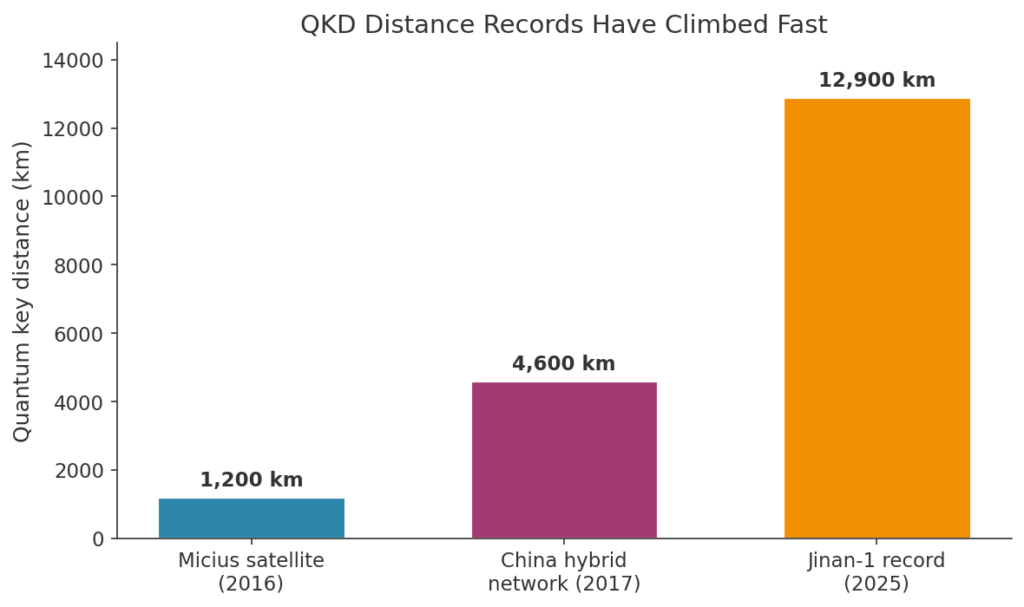
Figure 1: Record quantum key distances, from the Micius satellite to the Jinan-1 Beijing to Stellenbosch link (Nature, 2025).
The momentum has not slowed. In early 2025 a compact follow-up satellite, Jinan-1, set a record by sharing a secure key between Beijing and Stellenbosch in South Africa, roughly 12,900 kilometres apart, in a result published in the journal Nature. Commercial systems from a handful of specialist firms now run over standard telecom fibre, usually across tens of kilometres before a trusted relay is needed. The same physics that protects a city link is being tested to secure data across satellite networks on a global scale.
The Catch: QKD Is Not a Silver Bullet
For all its elegance, the technology carries real baggage. Photons cannot be amplified without breaking the very rule that protects them, so the signal fades with distance and fibre links are capped at a few hundred kilometres without help. Reaching further means trusting intermediate nodes, which quietly reintroduces the human trust the method was meant to remove. The equipment is specialised and costly, the line can be knocked offline simply by disturbing it, and real devices have side channels that researchers have exploited in the lab.
These are not fringe worries. The United States National Security Agency declines to approve QKD for its national security systems, and Britain’s National Cyber Security Centre takes a similar stance, both favouring the software route for the time being. The fair summary, including the limitations experts still point to, is that the technology is powerful but narrow, brilliant for a few high-value links and impractical for the open internet.
| Where QKD shines | Where it still struggles |
|---|---|
| Security anchored in physical law | Hardware is costly and specialised |
| Eavesdropping reveals itself | Range limited by signal loss in fibre |
| Future-proof against quantum computers | Trusted relays reintroduce trust |
| Ideal for long-life sensitive data | No built-in identity authentication |
Table 2: QKD is exceptional for a narrow set of needs, not a universal fix.
How QKD Is Changing the Way We Protect Data
So what is genuinely changing? The biggest shift is conceptual. For the first time, organisations can base the secrecy of a key on physical law rather than on the hope that a hard sum stays hard. For information that must remain private for decades, such as state secrets, financial records, and health archives, that promise is compelling enough to justify the expense and effort.
In practice the technology is becoming one layer in a larger defence rather than a wholesale replacement. Many designers now pair it with the software approach, so a single link is shielded by both physics and tougher maths at once. The road ahead points toward quantum repeaters that could extend range without trusted nodes, and satellite fleets that might knit national links into a worldwide quantum internet.
For an ordinary person, none of this calls for action today, because the technology lives in the backbone rather than on your laptop. The everyday rules still matter most, and sensible everyday cybersecurity habits protect you far more than any exotic hardware. For businesses, it is becoming one piece of a modern network security architecture that assumes the quantum era has already arrived.
Frequently Asked Questions
What is QKD in simple terms?
It is a way for two people to share a secret key using single particles of light. The key is then used with normal encryption to protect data. Its defining feature is that any eavesdropper trying to read the key disturbs the light and gives themselves away.
How does QKD detect an eavesdropper?
It relies on a rule of physics stating that quantum particles cannot be copied or measured without being changed. When a snooper measures the photons, they introduce errors. The two legitimate users check their error rate, and if it climbs too high they know someone interfered and simply discard the key.
Is QKD better than post-quantum cryptography?
Neither is strictly better; they solve the same problem in different ways. The software approach is cheaper, runs on existing networks, and scales easily, while QKD offers physics-based security for the most sensitive links. Many experts expect the two to be combined rather than chosen between.
Can I use quantum key distribution at home?
Not really, and you do not need to. It requires specialised hardware and dedicated fibre or line-of-sight links, so it lives in the infrastructure of governments, banks, and telecom carriers. Your everyday security still comes from strong passwords, updates, and the encryption already built into your apps.
Is quantum key distribution truly unbreakable?
In theory its security comes from physical law, which is as close to unbreakable as we know. In practice the security depends on real hardware, which can have flaws, and on a separate channel to verify identities. It is extraordinarily strong, but no real system is ever perfect.
The Bottom Line
For decades, securing a key meant trusting that a clever piece of maths would hold. Quantum key distribution offers something different: a key whose secrecy is enforced by the behaviour of light itself, with tampering written into the result for anyone to see. It will not replace the locks on your phone, and it is not a cure for every threat. Yet by anchoring the most sensitive exchanges in physics rather than arithmetic, it is quietly reshaping how the world protects the data that has to stay secret the longest.
References
NIST, What Is Quantum Cryptography? — https://www.nist.gov/cybersecurity/what-quantum-cryptography
National Quantum Initiative, NSA Cybersecurity Perspectives on Quantum Key Distribution and Quantum Cryptography — https://www.quantum.gov/nsa-cybersecurity-perspectives-on-quantum-key-distribution-and-quantum-cryptography/
Li, Y. et al., Microsatellite-based real-time quantum key distribution, Nature 640, 47-54 (2025) — https://www.nature.com/articles/s41586-025-08739-z
C. H. Bennett and G. Brassard, Quantum cryptography: Public key distribution and coin tossing (BB84), 1984.
UK National Cyber Security Centre, Quantum security technologies guidance — https://www.ncsc.gov.uk/whitepaper/quantum-security-technologies
Fact Check: All statistics, dates, and distances in this article were verified against original sources as of June 25, 2026. Sources are listed in the References section.