
Conversational AI has found its way into customer support queues, sales pipelines, lead qualification flows, and service desks across industries. The tech is accessible, implementation timelines have shortened, and the business case practically writes itself. So why do so many deployments fall flat within the first six months?
Usually, it’s a strategy problem. Most businesses rush to deploy an AI chatbot before they’ve answered a more fundamental question: what is this actually supposed to fix? When you start with the tool instead of the problem, you end up with an expensive FAQ page that frustrates customers rather than helping them. This article walks you through what a real conversational AI strategy looks like, and the specific mistakes that quietly kill most implementations.
For businesses exploring how conversational AI solutions can address these challenges, the first step is understanding where AI can genuinely make a difference.
Start With the Problem, Not the Platform
Before you open a single vendor comparison tab, get clear on what problem you’re solving. Most teams skip this. They see a demo, get excited, and start building workflows around features they may never need.
Ask yourself:
- Where are customers hitting friction right now?
- Where are your support agents burning time on repetitive, low-complexity work?
- Where are leads dropping off because follow-up is too slow?
The use cases that benefit most from conversational AI tend to share the same profile: high volume, relatively repetitive, and with a predictable resolution path. Think support response time reduction, repetitive query automation, lead qualification, product discovery, appointment scheduling, and order status updates.
Once you’ve identified the right problem, then you evaluate platforms.
A FAQ Bot Is Not Conversational AI
There’s a meaningful difference between a bot that pattern-matches keywords and returns a canned answer, and a system that understands what a customer is actually trying to do.
Here’s what that looks like in practice:
- Basic chatbot: “Where is my order?” → returns a tracking link.
- Conversational AI: “Where is my order?” → understands the intent, checks order status, delivers a contextual answer, handles the customer’s follow-up, without making them start over.
Real customers don’t ask questions in neat little formats. They give you half the context, use different phrasing every time, and often pivot mid-conversation. Design for the messiness of actual conversation, not the tidiness of a FAQ page.
Build From Real Conversations, Not Assumptions
Most AI strategies get built on what teams think customers are asking, rather than what they’re actually saying. Your best training data already exists. Pull from:
- Support chat logs
- Call transcripts
- Email threads and support tickets
- Sales conversations
- On-site search queries
Go through them looking for three things: questions that come up most often, the different ways customers phrase the same underlying request, and interactions that repeatedly escalate or go unresolved. That last category especially, the places where your current process breaks down are exactly where a well-designed AI layer can make the biggest difference.
Stop Trying to Automate Everything
There’s a ceiling on what AI should handle, and pushing past it creates a worse experience than not using AI at all. Think about interactions in three tiers:
AI-led
- FAQs and status checks
- Basic troubleshooting
- Lead qualification
- Simple, predictable requests
AI-assisted
- Complex support where AI retrieves info and summarises context, but a human makes the call
Human-led
- Sensitive complaints
- High-value negotiations
- Complex exceptions, a refund outside the standard window, an order that got lost in transit, a billing dispute that doesn’t fit the usual flow
- Any situation where a frustrated customer needs to feel genuinely heard
Define these tiers before you build, and you stop the system from overreaching.
Human Handoff is Not an Afterthought
The moment your AI can’t resolve something is the moment your customer’s patience is most at risk. What happens next determines whether they end up satisfied or escalated and annoyed.
A good handoff doesn’t just transfer the customer. It transfers the context. The human agent who picks up the conversation should immediately have the full chat history, the customer’s details, the intent the AI detected, the actions already taken, and why the escalation was triggered. Without that, you’re making the customer repeat themselves, which is one of the fastest ways to undo whatever trust the AI interaction had built.
This is where platforms like ConvoZen can help, giving support teams better visibility into conversations and making it easier for human agents to step in when needed.
Connect AI to Your Business Systems
An AI that can only answer questions has limited value. One that can actually take action on behalf of the customer is what creates a noticeably better experience.
When your conversational AI is integrated with your CRM, helpdesk, knowledge base, order management system, scheduling tools, and customer databases, you move from generic responses to genuinely useful ones.
The difference is easy to see: “Your appointment can be rescheduled” versus “Your appointment is set for Thursday at 11 am. Would Friday at the same time work for you?” The second response is only possible because the AI has access to real data and has been trained in a way that it sounds both professional and conversational.Integration directly determines how useful the AI experience feels to the customer on the other end.
Evaluate Platforms on What Actually Matters
When you’re ready to assess platforms, cut through the feature noise and focus on:
- Intent and context understanding
- Integration capabilities
- Automation and workflow support
- Human-agent handoff quality
- Analytics and conversation insights
- Scalability
- Security and data handling
- Channel support
Businesses evaluating their options can look at solutions like Convozen, which covers use cases across customer support, sales, and lead qualification. The key is to map any platform’s capabilities against the specific problem you’ve already defined.
Measure Outcomes, Not Volume
Conversation volume is the vanity metric of conversational AI. A high number of chatbot interactions tells you almost nothing about whether the deployment is working.
There are four areas of metrics worth keeping track of.
- Customer perspective: Customer satisfaction scores, resolution rate, and first-contact resolution rate.
- Operationally: Response time, agent workload, escalation rate.
- Business metrics: Lead conversion, qualified lead volume, and cost per resolution.
- AI performance specifically: intent accuracy, failed conversations, incorrect responses and escalation accuracy.
When you watch these numbers together, you get a clear picture of whether your conversational AI is streamlined and is genuinely helping or just generating activity.
A 5-Step Framework to Build Your Strategy
No drawn-out playbook needed. Here’s what the process actually looks like:
- Identify your biggest friction point: Where do your customers struggle the most, or where is your team spending time on things that shouldn’t require a human?
- Analyse your real support conversations, tickets and transcripts. Look for the repeats, the language customers use, and where things start to go wrong.
- Prioritise two or three use cases where AI can make a dent without overreaching. Don’t try to solve everything in round one.
- Integrate the systems your AI needs to actually resolve those use cases – not just answer questions about them.
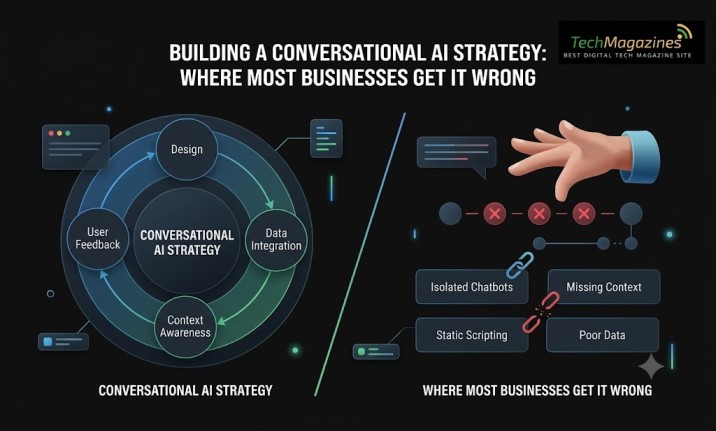
- Improve based on what the data tells you. Failed conversations are your most useful feedback loop.
Each cycle makes the system sharper. That’s the point, you’re building something that compounds, not deploying a tool and walking away.
Build for Outcomes, Not Just Automation
Conversational AI is not a chatbot to tick off the roadmap. When done well, it changes the experience a customer has with your business at some of the most critical times – when they need help, have a question or are deciding whether to buy or integrate within their system.
But none of that happens without a strategy grounded in real customer problems, built on actual conversation data, with clear boundaries on what AI should and shouldn’t handle, and measured on what actually matters.
So make your relevant interactions faster, more useful, and easier to resolve by creating the right conversational AI strategy.