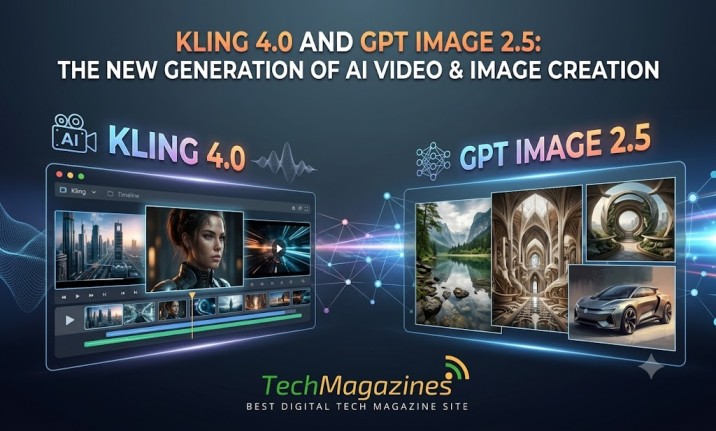

Artificial intelligence is changing the way creators produce videos, images, advertisements, social media content, and digital experiences. Two technologies gaining attention in the latest generation of AI creativity are Kling 4.0 and GPT Image 2.5. They focus on different parts of visual content creation: Kling is designed around AI video generation, while GPT Image 2.5 focuses on creating and editing images with greater precision.
These models are particularly useful for creators who want to move from an idea to finished visual content without relying on traditional production workflows. Platforms such as Atlas Cloud are also making multiple AI models available through a centralized environment, giving developers and creators access to a wider range of image and video generation tools. Atlas Cloud describes its platform as providing access to 300+ AI models through an OpenAI-compatible API.
Kling 4.0
Kling 4.0 is part of the newer generation of AI video-generation technology from Kling. AI video models are designed to transform text prompts, images, and other references into moving visual scenes. This can help creators produce advertisements, short films, product demonstrations, social media videos, concept scenes, and other forms of visual storytelling.
One of the major developments in Kling’s recent model family has been the focus on cinematic quality, consistency, and greater creative control. Kling’s 3.0 generation, for example, introduced multimodal workflows involving text, images, audio, and video, along with features such as text-to-video, image-to-video, reference-to-video, and in-video editing.
Atlas Cloud currently lists Kling 4.0 among its featured video models, alongside other modern AI video systems. This gives developers another way to integrate Kling capabilities into applications and automated creative workflows.
How Kling 4.0 Can Help Creators
AI video generation can significantly reduce the amount of time needed to create visual concepts. Instead of recording every scene manually, a creator can describe a scene and use an AI model to generate an initial version.
For example, a marketing team could create a product advertisement by describing the product, environment, camera movement, lighting, and mood. A filmmaker could experiment with different scenes before deciding which ideas deserve traditional production resources.
Consistency is also important. Characters, objects, environments, and visual styles need to remain recognizable when multiple shots are combined. Recent Kling development has placed considerable emphasis on maintaining visual consistency and giving creators more control over references and scenes.
Another important development in Kling’s ecosystem is native 4K video generation. Kling announced native 4K generation for its Kling 3.0 video series in April 2026, allowing compatible workflows to generate 3840×2160 content directly rather than relying solely on later upscaling.
GPT Image 2.5
GPT Image 2.5 is OpenAI’s newer image-generation model designed for sharper details, more natural lighting and textures, improved reference-image fidelity, and more precise editing. OpenAI announced ChatGPT Images 2.5 on September 8, 2026.
The model is not limited to generating an image from a simple text description. It is also designed to work with reference images and targeted editing instructions. This makes it useful when users want to modify an existing visual while preserving important elements such as the subject, composition, or overall visual identity.
OpenAI reports that Images 2.5 can provide up to 50% lower image-generation latency compared with Images 2.0, allowing users to generate and refine ideas more quickly.
Key Features of GPT Image 2.5
One of the most useful improvements is better image fidelity. When users provide reference photographs, the model is designed to preserve recognizable characteristics while placing the subject into new settings, compositions, or visual styles.
Another important feature is precision editing. Instead of regenerating an entire image from scratch, users can request focused changes. For example, they might change a product, background, piece of text, or another individual element while keeping much of the original composition intact.
GPT Image 2.5 also focuses on multi-turn editing consistency. This is valuable when creating marketing materials or other visual assets that require several rounds of changes. OpenAI says the model is better at maintaining earlier edits during subsequent modifications.
GPT Image 2.5 Flare and Sunburst
For developers, OpenAI has introduced two GPT Image 2.5 API models: GPT Image 2.5 Flare and GPT Image 2.5 Sunburst.
GPT Image 2.5 Flare is positioned as the faster option for high-quality everyday image generation. It accepts text and image inputs and supports several quality settings.
GPT Image 2.5 Sunburst is designed for workflows where editing precision is especially important. OpenAI describes it as its more capable option for image generation and editing, making it suitable for detailed creative workflows where users need tighter control over changes.
This distinction can be useful for businesses and developers. A high-volume content application may prioritize speed, while a professional design workflow may prioritize detailed editing and consistency.
Kling 4.0 vs GPT Image 2.5
Although both technologies belong to the generative AI ecosystem, their primary purposes are different.
Kling 4.0 is focused on video creation. It is suitable for users who want to generate moving scenes, cinematic concepts, advertisements, animations, and other video-based content.
GPT Image 2.5, on the other hand, is focused on still images and image editing. It can be useful for product photography, social media graphics, marketing visuals, creative concepts, presentations, and other image-based projects.
The two technologies can also complement each other. A creator might first generate a detailed product image using GPT Image 2.5 and then use an image-to-video workflow to turn that visual concept into a video. This type of workflow allows creators to combine image generation, editing, and video production instead of treating them as completely separate processes.
Why These AI Models Matter
The biggest change brought by modern generative AI is the reduction in the technical barrier to visual production. Previously, creating professional-looking video or image content could require cameras, editing software, designers, animators, studios, and significant production time.
AI does not eliminate the need for creative judgment, but it can accelerate many stages of the process. A creator can generate several concepts, test different styles, make revisions, and produce variations much faster.
For businesses, this can be useful for advertising and product content. For YouTubers and social media creators, AI can help with thumbnails, visual concepts, promotional videos, and storytelling. For developers, APIs such as those offered through Atlas Cloud can provide access to multiple models without requiring separate integrations for every model. Atlas Cloud says its platform provides access to more than 300 AI models across image, video, audio, language, and multimodal categories.
The Future of AI Visual Creation
Kling 4.0 and GPT Image 2.5 represent two different directions in the development of generative visual AI: increasingly sophisticated video generation and increasingly precise image creation and editing.
As these technologies improve, the creative process is likely to become more interactive. Instead of simply entering one prompt and accepting the result, users can create a visual, edit specific elements, provide references, generate variations, and then transform those visuals into other formats.
For creators, the important advantage is flexibility. A single idea can potentially become an image, an edited product visual, a social media post, and eventually a complete video campaign.
Conclusion
Kling 4.0 and GPT Image 2.5 highlight how quickly AI visual-generation technology is developing. Kling focuses on AI-powered video creation and increasingly sophisticated visual storytelling, while GPT Image 2.5 brings improvements in image quality, reference fidelity, editing precision, and generation speed.
For creators, marketers, developers, and businesses, these technologies provide new ways to experiment with visual content and shorten the distance between an idea and a finished asset. Platforms such as Atlas Cloud can further simplify this process by bringing multiple AI models together in one environment, allowing users to explore different tools according to their specific creative requirements.