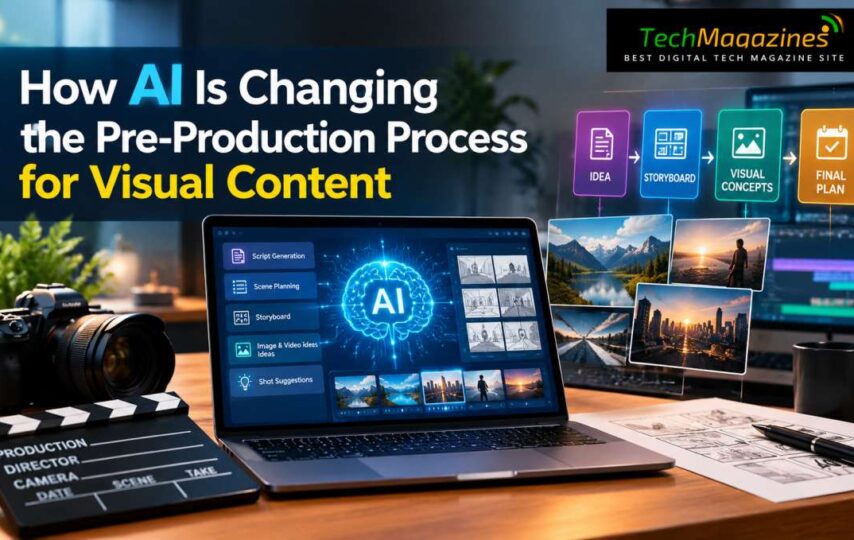

Producing visual content has traditionally involved a significant amount of planning before a camera is turned on or an animation begins.
Teams need to decide what a scene should look like, which characters are involved, where the action takes place, what the camera should capture, and how different scenes will connect.
Generative AI is changing this early stage of production.
Instead of keeping ideas inside documents and mood boards, creators can turn concepts into visual references much earlier. This makes it possible to test creative decisions before committing substantial time and resources to production.
Pre-Production Is Where Many Creative Decisions Begin
The final quality of a video is influenced by decisions made long before filming or editing.
A production team may spend days discussing:
- Locations
- Character appearances
- Camera angles
- Lighting
- Color palettes
- Scene transitions
- Product placement
- Overall visual style
Traditionally, these decisions might be communicated through sketches, reference photographs, written descriptions, or mood boards.
AI can add another layer: generated visual prototypes.
A team can create several interpretations of an idea and use them to decide which direction deserves further development.
Turning Written Ideas Into Visual References
A script can explain what happens in a scene, but it does not always communicate exactly how the scene should look.
Generative image tools can help bridge that gap.
For example, a script might describe a character walking through a crowded futuristic marketplace. Rather than leaving the description entirely to interpretation, a creative team can generate several visual versions of the environment.
One version might be dark and cinematic.
Another could be colorful and energetic.
A third might have a minimalist science-fiction aesthetic.
The team can then discuss the visuals rather than relying exclusively on written descriptions.
AI Image Models as Pre-Production Tools
AI image generation is becoming useful not only for finished artwork but also for planning.
Creators can develop character references, location concepts, product compositions, costume ideas, and environmental designs before the actual production begins.
Models such as Flux 3 image can be explored within this type of concept-development workflow, giving creators another way to visualize different artistic directions before deciding on a final approach.
The generated image does not have to appear in the finished project.
Its value may simply be that it helps the team understand what the project could look like.
Storyboards Can Become More Flexible
Traditional storyboards provide a visual sequence of planned shots.
The problem is that producing detailed storyboards can take significant time.
AI can make early storyboard exploration more flexible.
A creator can generate several possible frames for the same scene and compare different compositions before settling on one.
For example, a product advertisement might require:
- An establishing shot
- A close-up of the product
- A demonstration
- A lifestyle scene
- A final branding shot
AI-generated frames can help visualize how those shots might connect before production begins.
Testing Camera Ideas Without a Camera
Camera movement is another area where AI can help with experimentation.
A director may have an idea for a slow tracking shot but want to see whether the movement actually works with the composition.
AI video generation can provide a rough visual approximation.
The output does not need to be production-ready. It can simply answer a creative question:
Does this camera movement communicate the scene effectively?
Video-generation systems such as Seedance 2.5 Draft can be considered as part of this experimentation process, allowing creators to explore motion and scene concepts before committing to a final production method.
Marketing Teams Can Use the Same Approach
This workflow is not limited to filmmaking.
Marketing teams can use AI during campaign planning as well.
Suppose a company wants to launch a new product. Before producing the campaign, the team could visualize several creative directions:
Concept 1: Product-focused studio imagery.
Concept 2: Lifestyle photography.
Concept 3: Futuristic technology aesthetic.
Concept 4: Minimal editorial design.
Instead of choosing a direction based solely on descriptions, stakeholders can react to visual examples.
That can make creative discussions faster and more concrete.
AI Helps Identify Problems Earlier
One of the hidden benefits of visual prototyping is that it can reveal problems before production.
A proposed scene might sound impressive in a script but look visually confusing when represented as an image.
A character’s costume might not work against the planned environment.
A product may become difficult to see because of the chosen composition.
A particular camera angle might make an important action unclear.
Discovering these problems during planning is generally easier than discovering them after substantial production work has already been completed.
The Human Role Becomes More Strategic
AI can generate concepts quickly, but it does not decide which concept is appropriate for the audience.
That remains a creative responsibility.
A human director, designer, or marketer still needs to evaluate whether a visual:
- Communicates the intended message
- Fits the brand
- Supports the story
- Works for the target audience
- Can realistically be developed
- Feels distinctive enough to stand out
AI therefore becomes a tool for exploration rather than an automatic creative director.
From One Idea to Multiple Possibilities
Perhaps the biggest change is the number of possibilities creators can explore.
In a traditional workflow, testing ten different visual concepts might require substantial time.
With generative AI, the initial exploration stage can happen much faster.
That does not mean every concept will be useful.
In fact, many generated ideas may be discarded.
But discarded concepts can still be valuable because they help the creator understand what does and does not work.
A New Model for Creative Planning
The traditional process often looks like:
Brief → Discussion → Sketches → Storyboard → Production
An AI-assisted process can become:
Brief → AI Concepts → Visual Comparison → Storyboard → Motion Tests → Production
The difference is that visual feedback enters the process much earlier.
Creators can see possible outcomes before making major production decisions.
The Future of Pre-Production
As AI image and video models continue to develop, pre-production may become increasingly visual and interactive.
A director could move from a written scene description to multiple visual concepts, test camera movements, develop character references, and explore different versions of a sequence before production begins.
Image-generation models such as Flux 3 image and video-generation systems such as Seedance 2.5 Draft represent different pieces of this broader creative workflow.
The real opportunity is not simply generating more content.
It is using AI to make better creative decisions earlier.
When ideas can be visualized before production begins, teams can experiment more freely, identify problems sooner, and spend more of their production resources on the concepts that are worth developing.