
When people talk about digital transformation, the conversation usually revolves around artificial intelligence, cloud computing, cybersecurity, automation, or data analytics. Energy management rarely makes the list, yet it has quietly become one of the fastest evolving areas of industrial technology. What was once considered a facilities function is increasingly being driven by software, connected devices, real-time analytics, and intelligent automation.
That shift is happening for a simple reason. Modern industrial facilities generate an extraordinary amount of information, and businesses have finally reached the point where they can use that information to make better operational decisions.
Walk through a manufacturing plant today and you’ll find thousands of devices collecting data every second. Production equipment reports operating conditions continuously. Building automation systems monitor heating, cooling, and ventilation. Smart electrical meters measure consumption across production lines, while maintenance platforms track the performance of motors, compressors, pumps, refrigeration systems, and countless other assets. Enterprise software simultaneously records production schedules, inventory, labour utilization, and financial performance.
Individually, these systems are valuable. Together, they create an ecosystem of operational intelligence that extends far beyond traditional facilities management.
For many years, one of the biggest challenges was that these systems operated independently. Production teams focused on manufacturing metrics. Maintenance departments monitored equipment reliability. Finance teams tracked operating expenses, while facility managers reviewed utility invoices and electrical consumption reports. Each group had access to useful information, but very little of it was connected.
That is beginning to change.
The adoption of cloud computing, industrial IoT platforms, standardized communication protocols, and advanced analytics has made it possible to consolidate operational information into a single environment. Instead of looking at isolated reports, organizations can now evaluate relationships across the entire operation. They can see how equipment performance influences electricity consumption, how production schedules affect energy intensity, and how maintenance practices impact both operating costs and productivity.
This broader perspective is changing the role of energy within industrial organizations.
Electricity is no longer viewed simply as an operating expense. Increasingly, it is becoming another performance metric that helps explain how efficiently an organization is functioning. When electricity consumption begins to rise unexpectedly, the cause is often found somewhere else in the operation. A compressor may be operating outside its optimal range. Cooling equipment may require maintenance. Production schedules may have changed. Building controls may no longer reflect actual occupancy patterns.
Energy data therefore becomes a valuable diagnostic tool rather than simply another utility report.
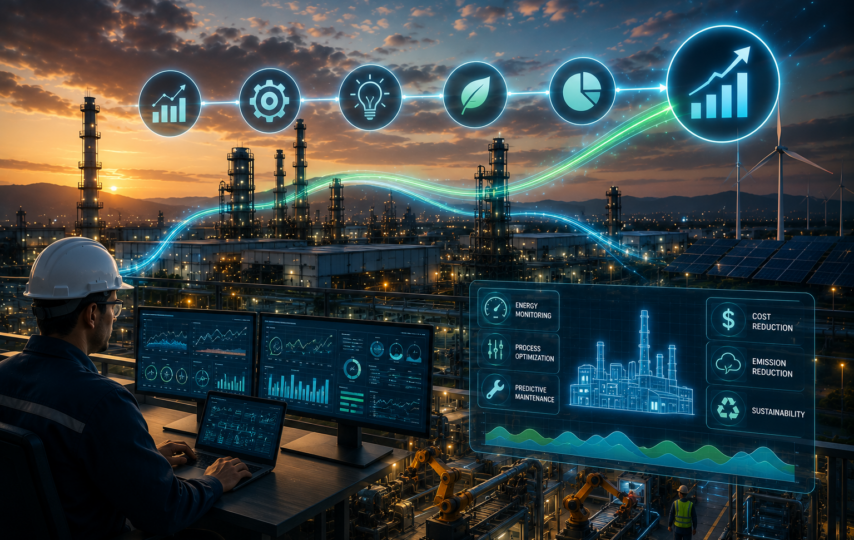
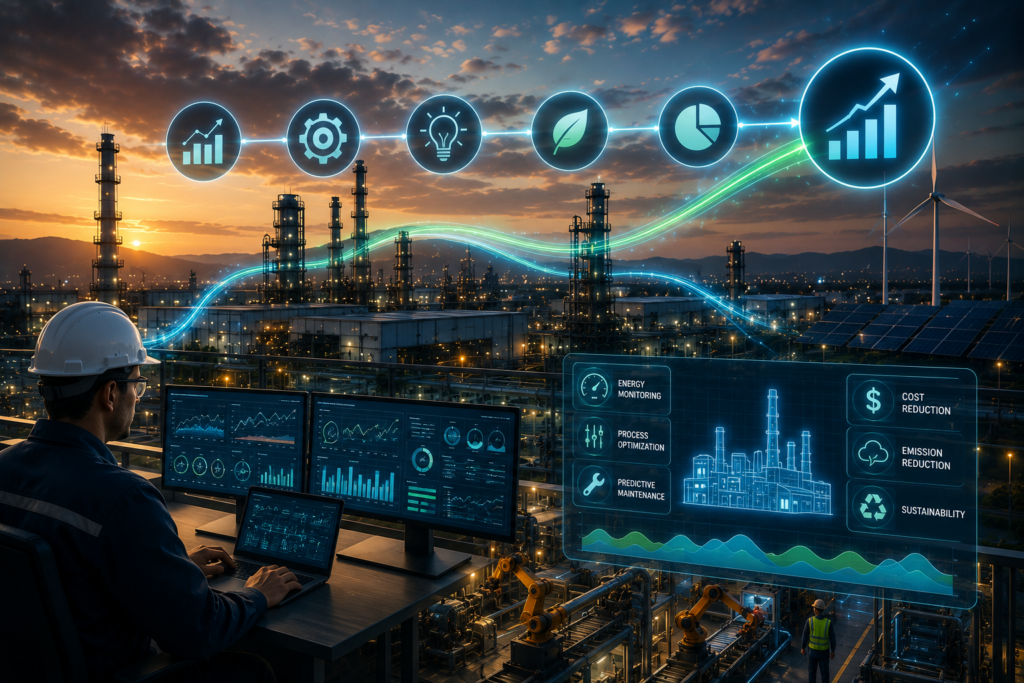
This is one reason businesses are investing in modern energy management system platforms. These solutions bring together electrical monitoring, operational data, asset performance, and building information into a unified view that allows organizations to identify inefficiencies, compare facilities, establish performance benchmarks, and make decisions based on real operational evidence instead of assumptions.
Artificial intelligence is accelerating this evolution, but perhaps not in the way many people expect. While headlines often focus on generative AI, one of the most valuable applications within industrial environments is predictive analytics. AI models can process millions of operational data points to identify gradual changes that may otherwise go unnoticed. Small shifts in electrical demand, declining equipment efficiency, or recurring operating patterns can all be detected much earlier, giving maintenance teams and operations managers the opportunity to respond before performance begins to suffer.
Another important development is the increasing availability of external market information. Businesses no longer have to rely solely on internal operational data to understand their energy performance. In jurisdictions such as Ontario, publicly available ieso market data provides detailed insight into electricity demand, grid conditions, market activity, and system performance. When organizations combine that external intelligence with their own operational information, they gain a much more complete understanding of how internal decisions interact with broader market conditions.
The result is a smarter, more connected approach to managing industrial operations, where technology supports not only production and maintenance but also long-term energy strategy.
One of the more interesting developments in this space is that energy management is no longer evolving independently from the rest of the business. It has become part of a much broader digital transformation that is taking place across industrial organizations. Companies that invest in automation, cloud platforms, predictive maintenance, and operational analytics are often discovering that energy data naturally becomes part of the same conversation.
That makes sense when you consider how closely electricity is tied to every aspect of an operation.
A production line cannot operate without power. Building automation systems rely on electricity to maintain environmental conditions. Warehouses depend on automated conveyors, robotics, and material handling equipment, while modern data centres require uninterrupted power to support business-critical applications. As organizations become more dependent on technology, they also become more dependent on understanding how energy supports that technology.
The Industrial Internet of Things has been one of the biggest drivers behind this change.
Connected sensors are now embedded throughout industrial facilities, continuously measuring temperature, pressure, vibration, electrical loads, equipment status, and dozens of other operating conditions. Instead of collecting information during periodic inspections, businesses now receive a continuous stream of operational data that reflects what is happening throughout the facility in real time.
That information becomes significantly more valuable when viewed in context.
A maintenance manager may notice that a motor is drawing more current than it did six months ago. Operations may observe that a production line consumes more electricity during certain shifts. Facility managers might identify HVAC equipment working harder than expected during periods of relatively low occupancy. Individually, each observation appears minor. Together, they often reveal operational trends that would have been almost impossible to detect using traditional reporting methods.
Artificial intelligence helps connect those dots.
Rather than expecting engineering teams to manually review millions of data points, AI can continuously evaluate information as it is collected, highlighting unusual operating conditions and identifying relationships that deserve further investigation. It does not replace experienced engineers or operators. Instead, it allows those professionals to spend less time searching for information and more time solving problems.
The value extends well beyond reducing electricity consumption.
Organizations that gain better visibility into their operations frequently improve maintenance planning, reduce equipment failures, extend asset life, and make better-informed capital investment decisions. Instead of replacing equipment based solely on age, companies can evaluate actual performance, maintenance history, and operating conditions before committing significant capital.
This represents an important shift in how industrial technology creates business value.
For many years, digital transformation projects focused primarily on improving productivity or automating repetitive processes. Those goals remain important, but businesses are increasingly looking for technologies that create value across multiple areas of the organization. Energy management has become one of those areas because operational efficiency, sustainability, maintenance, financial performance, and business resilience are all closely connected.
The cybersecurity implications are also becoming more significant.
As operational technology becomes increasingly connected, organizations must ensure that industrial control systems, energy monitoring platforms, and building automation networks are protected with the same level of attention given to traditional IT infrastructure. The convergence of operational technology and information technology is creating new opportunities for efficiency, but it also requires stronger governance, better network segmentation, and closer collaboration between engineering and IT teams.
Looking ahead, the pace of innovation is unlikely to slow.
Artificial intelligence will continue improving predictive analytics. Digital twins will allow organizations to model facilities and evaluate operational changes before implementing them. Edge computing will reduce latency by processing data closer to industrial equipment, while cloud platforms will make it easier to compare performance across multiple facilities and geographic regions.
These technologies will continue changing how organizations think about electricity.
Instead of treating energy as something measured after the fact, businesses will increasingly manage it as a real-time operational resource. Energy data will sit alongside production metrics, maintenance information, financial reporting, and supply chain analytics as another essential source of business intelligence.
Perhaps that is the biggest change taking place today. Energy management is no longer simply about reducing utility costs or achieving sustainability targets. It is becoming part of the digital foundation that supports smarter industrial operations. Organizations that successfully integrate energy data into their broader technology strategy will gain a more complete understanding of how their facilities operate, enabling better decisions, stronger operational performance, and greater resilience in an increasingly connected economy.
As industrial technology continues to evolve, companies that combine operational expertise with modern digital tools will be best positioned to take advantage of this transformation. The future of energy management is no longer confined to electrical rooms or facilities departments. It is being shaped by software, connected infrastructure, advanced analytics, and intelligent decision-making, making it one of the most important frontiers in the ongoing digital transformation of industry.