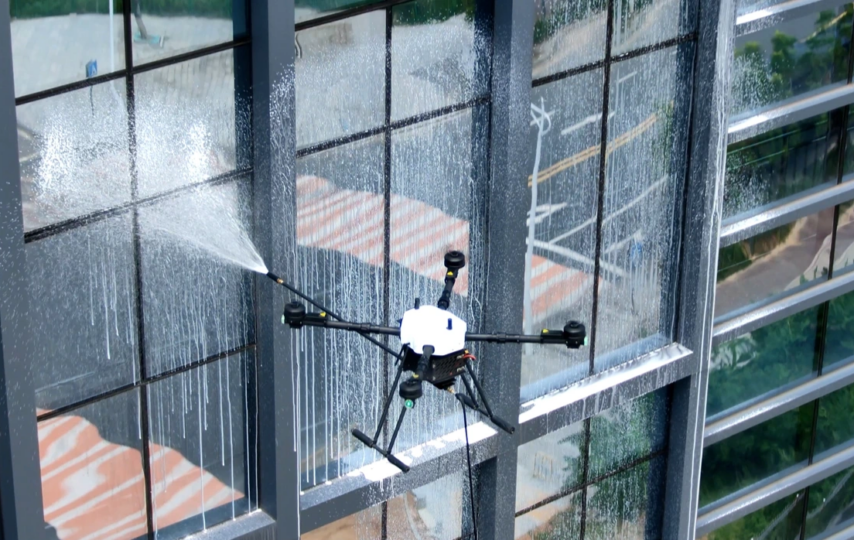

High-rise building maintenance is fraught with challenges: extreme safety risks for workers, ever-tightening regulations, and the constant pressure of high labor costs. As urbanization creates denser skylines, traditional cleaning methods involving rope access, scaffolding, and costly aerial lifts are becoming increasingly obsolete. This is where commercial window cleaning drones are revolutionizing the industry.
By leveraging advanced Unmanned Aerial Vehicle (UAV) technology, these drones offer a contact-free, high-pressure cleaning solution that keeps operators safely on the ground. This guide covers the cutting-edge technology powering this shift, the financial benefits of making the switch, and an in-depth look at the best solutions on the market, including the heavy-duty Jinghong series.
Market Context—Why The Shift to Drones is Accelerating
The global market for window-cleaning drones is experiencing explosive growth. Estimated at $260 million in 2025, the sector is projected to grow at a robust CAGR of 24.8% through 2033.
This surge is driven by three major factors:
- Safety Regulations: In places like Japan, safety rules are phasing out dangerous rope-access cleaning, creating urgency to adopt safer alternatives.
- Labor Shortages: Fewer young workers are entering the field of physical high-rise cleaning, leaving a gap that automated systems are perfectly suited to fill.
- Economic Pressure: Commercial drone washing typically offers a 40% cost reduction compared to traditional methods, while being 60-70% faster.
Drone-based cleaning eliminates the need for scaffolding, gondolas, or heavy lifts, directly addressing the risk of fall accidents and lowering insurance and compliance costs.
How Commercial Window Cleaning Drones Work
Unlike consumer camera drones, industrial cleaning drones are purpose-built for heavy lifting and precision washing. They typically feature a robust frame, high-pressure pumps, and specialized nozzles. The operational workflow combines sensor fusion and precision navigation:
Advanced Navigation and AI
Modern cleaning drones utilize SLAM (Simultaneous Localization and Mapping) technology and LiDAR sensors to scan building facades, identify window surfaces, and maintain a consistent distance. This allows the UAV to autonomously adapt to edges, corners, and window frames, ensuring a streak-free finish even in complex architectural geometries.
The Cleaning Mechanism
The drones do not rely on physical scrubbing (which could damage surfaces). Instead, they use a combination of chemistry and hydraulics: specialized cleaning solutions break down grime, while high-pressure, heated water (often deionized for a spotless finish) rinses the surface. For skyscrapers exceeding 100 meters, operators often utilize tethered power systems to allow for unlimited flight endurance and continuous water supply from the ground.
Jinghong Window Cleaning Drone Models
Jinghong Drone leverages over 30 independent patents and CE/FCC certifications to manufacture industrial-grade UAVs for the harshest conditions. Here are the flagship models:
1. JINGHONG CL65 – Super Sabre M Series (Best for Commercial)
Built for high-rise commercial building facades, industrial plants, and stadiums, the CL65 is the workhorse of the fleet.
- Build: Aviation-grade carbon fiber and aluminum alloy with IP67 waterproofing for severe weather.
- Capacity: Max take-off weight of 111 kg, capable of cleaning at altitudes up to 100 meters.
- Power: Optional ground pressurization system for strong water flow.
- Durability: Engine lifespan exceeding 100,000 hours and a frame service life of more than 10 years.
2. JH CL50 – Low-Altitude High-Pressure Drone (Versatile & Compact)
Optimized for mid-rise buildings up to 50 meters, shopping malls, and solar panel arrays.
- Build: Lightweight carbon fiber construction.
- Capacity: Max take-off weight of 60 kg.
- Advantage: Supports tethered power for unlimited endurance, ensuring you can finish the job without waiting for battery recharges.
Comparison: Jinghong CL65 vs. Competitors
| Feature | Jinghong CL65 | Apellix ($40k+) | Lucid ($20k-$40k) |
| Payload/Takeoff Weight | 111 kg | High | Medium |
| Material | Carbon Fiber + Aluminum | Industrial Alloy | Plastic Composite |
| Max Altitude | 100 Meters | High | Medium |
| Waterproofing | IP67 (Weatherproof) | Standard | Standard |
| Price Point | Competitive/Value | Premium+ | Premium |
| Durability | 10+ Year Frame Life | Standard | Standard |
Key Benefits & ROI (Return on Investment)
Transitioning to window cleaning drones is not just a safety upgrade; it is a significant business decision with measurable financial returns.
Cost Reduction
Using a drone can reduce cleaning costs by 25% to 35% compared to traditional manual methods. When you factor in the removal of equipment rentals (lifts/cranes), the savings are immediate. An initial drone investment of $5,000–$10,000 can often be recouped in about 6 months, ultimately reducing labor expenses by 30% to 50% over time.
Speed and Efficiency
Drones can clean 500 to 800 square meters per hour at heights of up to 25 stories. A cleaning job that used to take a crew days to set up and complete can now be finished in hours, minimizing disruption for building tenants.
Long-Term Asset Preservation
Regular, gentle cleaning (using hot water and deionized water) prevents the chemical etching and damage caused by harsh acid-based cleaners used in traditional methods. This helps preserve glass coatings and extends the lifespan of the building facade.
The Jinghong Advantage for Commercial Operators
Choosing the right equipment is critical for profitability. Jinghong commercial drones stand out due to their unique blend of heavy payload capacity, durability, and affordability.
- Unmatched Durability: While many competitors offer fragile plastic frames, Jinghong utilizes aviation-grade carbon fiber and 7075 aerospace aluminum. This provides a robust, rigid platform that minimizes body swing (maintaining < 0.1m hover precision) even in strong winds up to Level 7 (32–38 mph).
- All-in-One After-Sales: Jinghong provides complete operator training, simple maintenance guides, and guaranteed spare parts availability to minimize downtime.
- Safety as Standard: Following strict pre-flight checklists, weather safety protocols, and requiring 10m clearance during takeoff ensures human operators remain out of harm’s way.
Safety and Compliance (E.E.A.T.)
To comply with Google’s E.E.A.T. guidelines, it is vital to address safety and regulation. Drone cleaning is subject to strict aviation laws.
- Regulatory Compliance: In the US, operators must be licensed under FAA Part 107, which restricts flights to Visual Line of Sight (VLOS) and altitudes below 400 feet unless a waiver is obtained. In Europe, operators must complete a SORA (Specific Operations Risk Assessment) to secure permits.
- Operational Safety: Never operate in adverse weather (high wind, rain, dense fog). Jinghong drones are built with emergency Return-to-Home (RTH) protocols and require a thorough pre-flight checklist covering battery levels, propulsion integrity, and GNSS signal strength before every mission.
Frequently Asked Questions (FAQs)
Q1: Can a window cleaning drone really clean glass without touching it?
A: Yes. Experienced drone operators use soft wash solutions and surfactants to break down organic grime. For glass, high-pressure deionized water is used, which evaporates to leave a streak-free finish without requiring physical wiping.
Q2: How much does a commercial window cleaning drone cost?
A: Prices vary greatly. Professional high-rise cleaning drones like those from Lucid or Apellix can range from $20,000 to $40,000+. Jinghong offers highly competitive industrial models with heavy payloads at lower investment thresholds.
Q3: Is drone cleaning safe for the building?
A: Absolutely. Drone cleaning is significantly safer for buildings than traditional acid-based methods. Drones use precise water pressure and neutral chemistry that prevents damage to window seals, coatings, and frames.
Q4: What height can a commercial cleaning drone reach?
A: Jinghong drones are rated for altitudes up to 100 meters, effectively covering 25–30 story buildings. High-lift versions and tethered systems can exceed this if local regulations and airspace restrictions allow.
Q5: How do I start a drone window cleaning business?
A: You need to pass a knowledge test (FAA Part 107 in the US or equivalent), purchase a heavy-lift drone (like the CL65), and invest in hands-on flight and wash system training. It is not a turnkey business; real-world flight experience is essential for safety and quality results.
Q6: What surfaces can these drones clean besides windows?
A: They are highly versatile. Jinghong cleaning drones are also used for solar panel arrays, wind turbine blades, rooftops, gutters, stadiums, and metal facades.
Q7: What wind speeds can Jinghong cleaning drones handle?
A: The CL50 and CL65 models are rated for operation in Wind Speed Level 7 (32–38 mph / 50–61 km/h).
Conclusion
The era of hanging off scaffolding with a squeegee is fading. Driven by safety demands and economic pressures, the adoption of commercial window cleaning drones is one of the most significant trends in facility maintenance today.
For building owners, the choice is clear: drone cleaning provides a 40% reduction in costs, a 70% reduction in cleaning time, and eliminates the risk of worker injuries. For entrepreneurs, it represents a high-margin opportunity with an unmatched ROI.
When selecting your equipment, focus on build quality and safety. Jinghong industrial drones deliver the necessary heavy-lift capacity, weatherproof durability (IP67), and precision control required to tackle modern architecture safely.