
Digital audio systems depend on more than simply transferring numerical samples from one component to another. Timing accuracy, clock stability, electrical isolation, signal routing, and data buffering all influence how reliably a digital audio stream reaches the DAC. This is where a dedicated digital-to-digital converter (DDC) can become an important part of a high-resolution audio architecture.
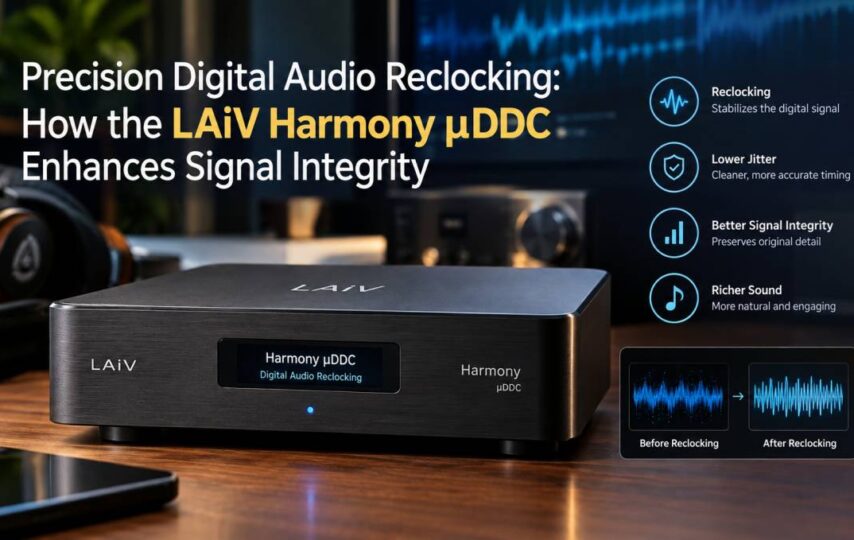
The LAiV Audio’s Compact Digital to Digital Audio Converter (µDDC) is designed around this engineering challenge. Rather than converting digital audio into an analogue signal, the Harmony µDDC receives a digital stream, processes its timing, reclocks the data, and delivers a refined digital output to the downstream DAC.
Digital Audio Timing and the Role of a DDC
A digital audio signal consists of precisely timed samples. The data itself may be correct, but timing variations can occur as the signal passes through USB interfaces, streaming transports, computers, or other digital components.
The Harmony µDDC addresses this through a dedicated reclocking architecture. It sits upstream of the DAC and processes the incoming digital stream before forwarding it to the next component. This makes the DDC fundamentally different from a conventional DAC: its primary job is digital signal management rather than analogue conversion.
The architecture is particularly relevant in high-resolution systems where stable clocking and predictable signal timing become increasingly important.
Ultra-Low Phase Noise Femto Clock
Clock technology is one of the central engineering features of the µDDC. The unit uses an ultra-low phase noise femto clock designed to provide highly precise timing for digital signal processing.
In a digital audio system, the clock determines when samples are processed and transmitted. Lower phase noise can help create a more stable timing reference for the signal path.
The Harmony µDDC also provides an external 10MHz master clock input. This allows the device to be synchronised with a compatible external reference clock, making it possible to integrate the converter into more advanced clocking architectures.
FIFO Buffer and Reclocking Architecture
The µDDC combines a proprietary FIFO (First-In, First-Out) buffer with its reclocking system.
A FIFO buffer temporarily stores incoming digital data before releasing it according to the converter’s internal timing reference. Instead of simply passing data through at the same timing characteristics as the source, the system can reorganise the transmission around its precision clock.
This architecture is particularly useful when a digital source has timing characteristics that are less controlled than those of the downstream audio system.
The reclocking stage then provides a controlled digital output for the DAC, creating a clearly defined boundary between the incoming source signal and the regenerated digital stream.
FPGA and CPLD Signal Processing
Digital processing inside the µDDC is handled using FPGA and CPLD technologies.
The FPGA provides programmable digital logic for signal routing and processing. Because FPGAs can perform multiple digital operations with highly controlled timing, they are well suited to complex audio signal-management tasks.
A CPLD complements the FPGA by handling dedicated logic functions associated with timing and signal control. In the µDDC architecture, these technologies work alongside the clock and FIFO system to maintain consistent digital processing.
The specifications support high-resolution formats, including PCM up to 768kHz and DSD up to DSD512 for compatible inputs. This provides substantial bandwidth for modern high-resolution digital audio systems.
Galvanically Isolated I²S Connectivity
Another significant engineering feature is galvanic isolation on the I²S output.
Digital equipment can sometimes transfer unwanted electrical interference through shared electrical paths. Galvanic isolation creates an electrical barrier between circuits, helping prevent certain forms of noise from travelling directly between connected components.
For the µDDC, this isolation is implemented on the I²S outputs. I²S is a digital audio interface commonly used internally and between selected high-end audio components because it can carry audio data and clock-related signals in a direct digital format.
The result is an architecture designed to separate the converter’s processing environment from the downstream digital audio device.
Multiple Digital Input and Output Options
Connectivity is another important part of the converter’s engineering.
The Harmony µDDC provides USB, I²S, AES/EBU, and coaxial digital inputs, while digital outputs include I²S and USB depending on the configuration and signal path. The device also provides the dedicated 10MHz clock input for external synchronisation.
Its supported formats vary according to the input. USB and I²S support PCM from 44.1kHz through 768kHz and DSD64 through DSD512, while AES/EBU and coaxial inputs support PCM up to 192kHz and DSD64 through DoP.
This makes the converter adaptable to different digital-source architectures rather than restricting it to one connection standard.
CNC Aluminium Construction and Thermal Design
The physical enclosure also contributes to the engineering of the device. LAiV Audio uses a unibody CNC-machined aluminium chassis for the Harmony µDDC.
A rigid metal enclosure provides mechanical strength while also helping with thermal management and electromagnetic shielding. Digital processing hardware, clocks, power circuitry, and interface electronics all operate within a compact enclosure, so managing heat and unwanted electrical interference is important.
The µDDC weighs approximately 0.6kg and is deliberately designed as a compact component for desktop and high-end audio installations.
Designed for Modern High-Resolution Systems
The LAiV Audio’s Compact Digital to Digital Audio Converter (µDDC) demonstrates how a relatively small digital component can incorporate sophisticated signal-processing technology.
Its combination of precision clocking, FIFO buffering, FPGA/CPLD processing, reclocking, galvanic isolation, multiple digital interfaces, and external master-clock compatibility gives system designers several ways to integrate it into a high-resolution audio chain.
For users building a digital audio system around a capable DAC, the engineering value of a DDC lies in controlling the digital signal before conversion takes place. Rather than changing the fundamental audio content, the technology focuses on how reliably that information is timed, processed, isolated, and delivered to the next stage.
As digital audio systems continue to support higher sampling rates and increasingly complex source architectures, technologies such as precision clocking, programmable digital processing, buffering, and electrical isolation will remain important elements in maintaining a controlled signal path.