
Peptides sit at the intersection of biology and chemistry, acting as hormones, signaling molecules, enzyme inhibitors, and increasingly as therapeutic drugs. Producing them in the lab requires precision, because even a single incorrect amino acid can change how a peptide folds, binds, or functions. Among the many peptide synthesis methods developed over the past several decades, solid-phase peptide synthesis, commonly abbreviated as SPPS, has become the dominant approach used in academic labs, biotech companies, and pharmaceutical manufacturing. This article explores the underlying chemistry that makes SPPS work, the reagents and reactions involved, and why this method has become the gold standard for building peptide chains.
What Is Solid-Phase Peptide Synthesis?
Solid-phase peptide synthesis is a technique in which a peptide chain is assembled one amino acid at a time while anchored to an insoluble solid support, typically a resin bead. The method was pioneered by Robert Bruce Merrifield in the early 1960s, an innovation that later earned him the Nobel Prize in Chemistry. Before SPPS, peptide synthesis happened almost entirely in solution, a slow and cumbersome process that required purifying the product after every single coupling step.
SPPS solved this problem elegantly. Because the growing peptide chain stays attached to a solid resin throughout the entire synthesis, excess reagents and byproducts can simply be washed away with solvent after each reaction step. This eliminates the need for repeated purification during the synthesis itself, dramatically speeding up production and improving yields. Only at the very end of the process is the finished peptide cleaved from the resin and purified.
The Solid Support: Resins and Linkers
The foundation of SPPS is the resin, a polymer bead that provides a stable, insoluble platform for chain assembly. Common resin materials include polystyrene cross-linked with divinylbenzene, as well as polyethylene glycol-based resins that offer better swelling properties in a wider range of solvents.
Attached to the resin is a linker molecule, which connects the first amino acid to the solid support and determines how the final peptide will be released. Different linkers produce different results once cleavage occurs:
- Wang resin linkers release peptides with a free carboxylic acid at the C-terminus.
- Rink amide linkers release peptides with a C-terminal amide, which is common in many natural peptide hormones.
- Trityl-based linkers are often chosen for their acid sensitivity, allowing milder cleavage conditions.
Choosing the correct resin and linker combination is one of the first strategic decisions a chemist makes, since it affects not only the final structure of the peptide but also the conditions required for cleavage later in the process.
Protecting Groups: Fmoc and Boc Chemistry
Amino acids contain multiple reactive groups, including an amine, a carboxylic acid, and often a reactive side chain. If left unprotected, these groups would react indiscriminately during synthesis, producing branched or scrambled products instead of a single, defined peptide sequence. To prevent this, chemists use protecting groups that temporarily block reactivity at specific sites until the chemist is ready to deprotect them in a controlled way.
Two major protecting group strategies dominate modern peptide synthesis methods.
Fmoc Chemistry
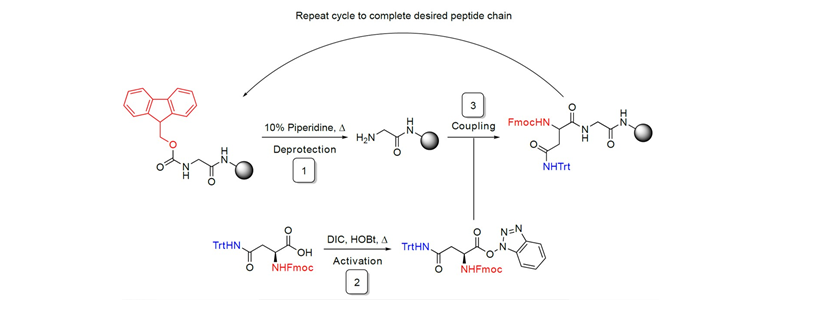
Fluorenylmethyloxycarbonyl, or Fmoc, is a base-labile protecting group used to shield the alpha-amino group of each incoming amino acid. It is removed using a mild base, typically a solution of piperidine in dimethylformamide. Fmoc chemistry has become the more widely used approach today because it avoids the need for strong acids during the repeated deprotection steps, making the process gentler on sensitive side chains and safer for routine laboratory use.
Boc Chemistry
Tert-butyloxycarbonyl, or Boc, is an acid-labile protecting group that requires treatment with trifluoroacetic acid for removal at each cycle, and hydrogen fluoride for the final cleavage from the resin. Boc chemistry was the original method used by Merrifield and remains useful for certain complex or hydrophobic peptides, though its reliance on hazardous hydrogen fluoride has made it less common in standard laboratory settings compared to Fmoc chemistry.
Side chains of amino acids like lysine, serine, cysteine, and glutamic acid also carry their own protecting groups, chosen to survive the repeated deprotection cycles of the alpha-amine while remaining removable during the final global deprotection step.
The Coupling Reaction: Forming the Peptide Bond
The core chemical event in SPPS is the coupling reaction, in which a new amino acid is joined to the growing peptide chain through the formation of an amide bond. This reaction does not happen spontaneously between a free amine and a free carboxylic acid, so the carboxylic acid must first be activated to make it more reactive toward nucleophilic attack.
Activation is typically achieved with coupling reagents such as:
- HBTU or HATU, which are among the most widely used activating agents in modern SPPS
- DIC combined with additives like Oxyma or HOBt to suppress side reactions
- PyBOP, another popular phosphonium-based coupling reagent
These reagents convert the carboxylic acid into a reactive intermediate, often an active ester, which then reacts efficiently with the free amine on the resin-bound peptide chain. A base such as diisopropylethylamine is usually added to neutralize the reaction and maintain proper pH conditions.
Coupling efficiency must be extremely high at every single step, since a synthesis of even twenty amino acids involves dozens of individual reactions. If each coupling step achieves 99 percent efficiency, the cumulative yield after twenty couplings still drops to roughly 82 percent, illustrating why chemists work so hard to optimize each reaction.
The Synthesis Cycle
Each round of SPPS follows a repeating cycle of chemical steps:
- Deprotection of the alpha-amino group on the resin-bound peptide
- Washing to remove the deprotection reagent and byproducts
- Activation of the incoming protected amino acid
- Coupling of the activated amino acid to the free amine
- Washing to remove excess reagents
- Optional capping of any unreacted amine groups, usually with acetic anhydride, to prevent deletion sequences
This cycle repeats for every amino acid in the target sequence, building the peptide from the C-terminus toward the N-terminus, one residue at a time. Many modern peptide synthesizers automate this cycle entirely, using programmable instruments that deliver reagents, control reaction times, and perform washes without manual intervention.
Monitoring the Reaction
Because coupling reactions are not always complete, chemists use monitoring techniques to check for unreacted amine groups before moving forward. The Kaiser test is a classic colorimetric method that uses ninhydrin to detect free primary amines, turning the resin a deep blue color if unreacted amine groups remain present. Other tests, such as the chloranil test, are useful for detecting secondary amines found in proline residues. Catching an incomplete coupling early allows the chemist to repeat the reaction before adding the next amino acid, preventing the accumulation of deletion sequences in the final product.
Cleavage and Global Deprotection
Once the full peptide sequence has been assembled, it must be cleaved from the resin and stripped of all remaining side chain protecting groups. For Fmoc-based synthesis, this is usually accomplished with a cocktail based on trifluoroacetic acid, often combined with scavengers such as triisopropylsilane and water. These scavengers trap reactive cations generated during deprotection, preventing them from reattaching to sensitive side chains like those on tryptophan or cysteine.
After cleavage, the peptide is typically precipitated in cold diethyl ether, then purified using high-performance liquid chromatography to separate the target peptide from truncated sequences, deletion products, or other impurities. Mass spectrometry is commonly used afterward to confirm that the final product matches the expected molecular weight.
Why SPPS Dominates Modern Peptide Synthesis Methods
Among all peptide synthesis methods available today, SPPS offers several distinct advantages that explain its widespread adoption:
- Simplified purification, since excess reagents are removed by simple filtration and washing rather than extraction or chromatography after every step
- Compatibility with automation, allowing high-throughput production of peptide libraries
- Flexibility to incorporate non-natural amino acids, labels, or modified residues at specific positions
- Scalability, ranging from small research quantities to large-scale manufacturing for peptide-based drugs
That said, SPPS is not without limitations. Longer peptides, generally beyond fifty amino acids, become increasingly difficult to synthesize with high purity due to the cumulative effect of small inefficiencies at each step. In these cases, chemists often turn to native chemical ligation, a technique that joins two or more shorter peptide fragments, each synthesized separately using SPPS, into a single longer chain.
Frequently Asked Questions
What is the main advantage of solid-phase peptide synthesis over solution-phase synthesis? SPPS allows excess reagents and byproducts to be removed by simple filtration and washing after each step, since the growing peptide remains attached to an insoluble resin. This avoids the need for repeated purification that solution-phase synthesis requires.
What is the difference between Fmoc and Boc chemistry? Fmoc protecting groups are removed with mild base, while Boc protecting groups require strong acid for removal at each cycle and hydrogen fluoride for final cleavage. Fmoc chemistry is more commonly used today because it avoids hazardous reagents during routine synthesis.
Why are coupling reagents like HATU or HBTU necessary? Carboxylic acids do not react efficiently with amines on their own. Coupling reagents activate the carboxylic acid, converting it into a reactive species that can form an amide bond with the free amine much more readily.
How long can a peptide be before SPPS becomes impractical? Peptides beyond roughly fifty amino acids often suffer from lower purity due to accumulated small errors at each coupling step. For longer sequences, chemists frequently use fragment coupling or native chemical ligation to join shorter, independently synthesized peptides.
How is a completed peptide separated from the resin? A cleavage cocktail, typically based on trifluoroacetic acid for Fmoc chemistry, breaks the bond between the peptide and the resin while also removing side chain protecting groups. Scavenger molecules in the cocktail help protect sensitive residues during this step.
How is the purity of a synthesized peptide confirmed? High-performance liquid chromatography separates the target peptide from impurities such as truncated or deletion sequences, and mass spectrometry confirms that the molecular weight matches the expected sequence.
The Future of Peptide Chemistry
Solid-phase peptide synthesis transformed peptide chemistry from a slow, laborious process into an efficient, largely automated technique capable of producing everything from research reagents to life-saving therapeutics. As demand grows for peptide-based drugs, including treatments for diabetes, obesity, and cancer, the chemistry underlying SPPS continues to evolve. New coupling reagents, greener solvents, and improved resins are all active areas of research, aimed at making peptide production faster, cleaner, and more sustainable. Understanding the fundamental chemistry behind protecting groups, activation, coupling, and cleavage remains essential for anyone working with peptides, whether in an academic lab or an industrial manufacturing setting.