
In contrast to traditional techniques, Agile project management views change not as an anomaly but as an inevitable and desirable part of the process. Since project scopes are locked in early in classic linear methodologies like Waterfall, modifications made in the later stages become costly and inflexible. The Agile Manifesto, on the other hand, emphasizes the significance of reacting to change instead of following a schedule, which helps organizations to easily adjust and preserve their edge in the market.
Change is vital in Agile project management due to the following critical drivers:
Factors Influencing Agile’s Evolution:
- In traditional software development, requirements are gathered, then coding is designed and implemented, and after deployment, verification and maintenance are performed. In traditional project management methodologies such as Waterfall, you only move to the next stage after the earlier stage is complete. So, the last four decades saw a need to modernize project management due to the historical approaches’ errors and weaknesses and the requirements of the modern period.
- Stakeholders don’t always have a complete vision of a project at the outset; hence, it’s only natural for user needs to alter as the project continues.
- Constantly changing competitive landscapes and modern technologies make rigid, long-term plans quickly outdated.
- Short delivery cycles (called sprints) produce user feedback, leading to quick project improvements.
- Consistent adjustments help find mistakes early. This keeps organizations from making expensive products that do not meet the original market demands.
What is Agile in software development and its importance:
What does Agile mean to you? When I first searched this term online, I found many different interpretations of the word “agile.” Many perspectives exist on Agile, and one of the most practical is the scrum framework: an Agile approach that helps teams work collaboratively and iteratively to deliver high-value products in small increments through time-boxed sprints. Scrum relies on three core pillars: transparency, inspection, and adaptation. Some people describe Agile as a cyclical method for delivering software. For others, it means getting results quickly while spending less time and money. Agile is often defined as the ability to adapt and to enable the change. It reflects a concept focused on the rapid and iterative delivery of applications, which is why project managers, software developers, Agile practitioners, and organizations use Scrum to respond faster to changing requirements and customer feedback. Over time, the phrase “Agile” has grown to reflect this larger mindset. However, some claim that Agile is not a full answer, but rather a collection of tools and practices driven by a particular way of thinking.
While these descriptions are not wrong, the real meaning of Agile can be found in the Agile Manifesto, and this article connects those principles to Scrum, its roles, benefits and drawbacks, the shift from Waterfall to Agile, common adoption mistakes, and practical ways to implement Agile change well.
The origin story of Agile is that in early 2001, a group of 17 remarkable individuals came together over a weekend to share their experiences, ideas, and practices related to software development. They wanted to discuss the best ways to express these concepts and suggest improvements to the software development landscape. They could not have imagined the major impact their meeting would have on the future of project management. They all agreed that companies were so focused on extensive planning and documentation of their software development processes that they ignored what truly mattered: satisfying their customers.
Companies may have promoted corporate values such as excellence and integrity, but these values did little to help people, particularly software developers, find better ways of working. That needed to change. These leaders then created the Agile Manifesto, an intentionally streamlined expression of core development values; the Agile Principles, a set of 12 guiding concepts that help project teams implement Agile techniques and stay on track; and the Agile Alliance, a community development organization dedicated to assisting individuals and organizations that use Agile principles and practices.
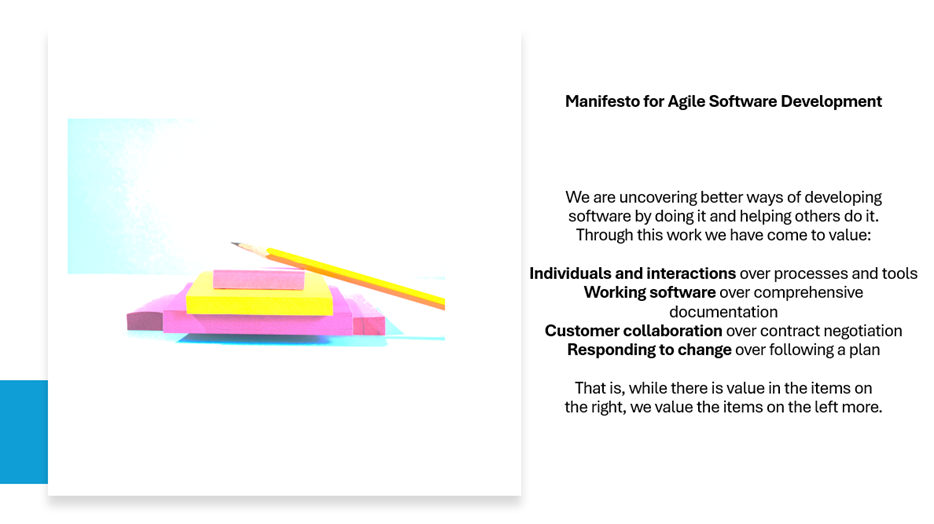
In short, the Agile Manifesto is a list of ideals and beliefs that give people a common ground for deciding how to best go about developing software. Read and understand the Agile software development Manifesto if you want to be serious about learning an Agile mindset.
Credit/Source: https://agilemanifesto.org/
It’s about improving software development by doing it ourselves and helping others do the same. Through this work, we have gained valuable insights and experience. The first value in the Agile Manifesto emphasizes individuals and their interactions over processes and tools. This is the hub of the Agile study. It shows a 50-fold increase in performance when individuals and interactions are correctly captured.
People are more important than processes or tools. This is understandable as people respond to business demands and drive the development process. If the process or tools drive development, the team is less responsive to change and less likely to meet customer needs. One example of the distinction between valuing people vs. processes is communication. People respond as needed, when communication is well-planned for a process with clear content. Communication must be fluid and continuous, not defined and scheduled. Agile is not about working in isolated silos.
The next value is functional software over extensive documentation. A full fifty-page functional specification document is developed to specify all aspects of the website’s functionality, including extensive wireframes. Although significant time and effort are invested in its creation, new requirements soon render the document outdated. Maintaining and updating the specification is tedious and time-consuming. That means the document will end up in the archive. More value is placed on the actual building of the website where the focus is placed on the output and not so much on the documentation. Focus on building and measurable output is key to making meaningful progress and keeping the end goal of building a working and effective solution in mind. While Agile does not cut the documentation times, it simplifies it to provide developers with the essential information they need for their tasks. The Manifesto recognizes the importance of documentation, but it prioritizes functioning software even more.
The third value emphasizes customer collaboration over contract negotiation. Negotiation involves the customer and the product manager discussing the specifics of a delivery, with opportunities for adjustments along the way. Collaboration, however, is a completely different concept. In development methodologies like Waterfall, customers complete the product requirements, often in extensive detail, before any work begins. This means that the customer is engaged in the development process before it starts and after it finishes, but not during the process. The Agile Manifesto specifies a client who is actively involved and contributes throughout the project lifecycle process. This significantly improves the development team’s ability to meet the customer needs. Instead of setting a contract in stone at the start of the project, it tries to fix as little as possible through customer collaboration. Collaborate closely with your clients to make decisions during the project. Give stakeholders what they want and avoid future issues.
The next value is more about adapting to change and less about sticking to a plan. Research has shown that 64% of features developed using the Waterfall paradigm are rarely or never used (originates from a Standish Group study presented by Jim Johnson at the XP 2002 conference). This is where Agile starts to push out more on traditional Waterfall approaches. Waterfall methodologies set out all requirements, costs, and times up front, whereas Agile allows and welcomes change. Change is good, isn’t it? How many of your project plans have gone exactly per schedule? Not too many, I suppose. So let us be Agile.
What Agile is not?
In the earlier section we looked at what Agile is, but there are different interpretations of what it is; let’s look at what Agile is not. The Manifesto clarifies that Agile is not a process or method nor a particular way of software development. This is not a process or framework standard nor an end. Rather it is a journey of continuous improvement. It is not an excuse to reduce documentation or an opportunity to drop planning. It’s not one size fits all, but a tailored approach to the needs, vision, and culture of an organization. It’s not Scrum. In fact, Scrum is something that follows Agile principles, and similarly, it’s not Kanban. Kanban also uses Agile principles.
To summarize what Agile is, as we discussed, it’s any process that aligns with the values of the Agile Manifesto. Secondly, Agile refers to a set of approaches to software development emphasizing incremental delivery and an iterative approach. It is often described as agile development: a product-focused way of working that blends Agile thinking, Lean, and UX to guide roadmaps through change. It emphasizes lean processes and building the smallest practical products that go through iterations before the final product is developed. Agile promotes constant feedback from the end users. It’s a much more dynamic process with everyone working together for one goal, resulting in faster speed to market and better ability to respond to market needs. Customer feedback is constantly collected and implemented. One important thing is that Agile is not only meant for software development. Agile project management techniques have spread beyond software development and even beyond computer-related products.
Scrum is an Agile framework that helps teams work collaboratively and iteratively to deliver high-value products incrementally. It divides complex, unpredictable projects into manageable, time-boxed cycles called sprints, though planning can be harder because dependencies may be less explicit than in Waterfall, which can complicate coordination across work streams.
The three Specific Roles
- Product Owner: Manages, prioritizes, and clearly communicates the items on the product backlog to maximize the value of the product.
- Scrum Master: Coaches the team in the application of Scrum theory and helps to remove workplace impediments.
- Developers: Cross-functional professionals who are dedicated to building any part of a usable increment in each sprint.
Advantages and Disadvantages of Scrum teams:
So far, we have seen that Scrum has many advantages:
- The first benefit is that it’s more transparent, and it gives you more visibility into the project. So, with the daily stand-up meetings, the whole team knows who is doing what, and issues are found in advance that improves the communication, enabling the team to mitigate the issues right away.
- It raises the bar for the team. Not only the project manager but the team collaborates and is accountable for deciding what work they can deliver in each sprint.
- The succeeding iteration is straightforward to adapt; therefore, it is simpler to execute brief sprints and receive consistent feedback.
- It is good for fast-moving development projects.
- It’s less expensive as it prevents you from wasting money on the wrong things.
- Constant communication makes sure that the team knows about problems and changes earlier, helping reduce costs and improve quality.
- It ensures and provides for efficient use of time and money.
- It speeds up delivery.
- Scrum can help teams in delivering project deliverables efficiently and quickly.
- Scrum is Agile and takes continuous feedback from customers and stakeholders. Customers are heard that improves the product and avoids any issues later.
While Scrum provides some tangible benefits, it also has some drawbacks –
- Scrum requires a lot of experience and dedication from the team.
- One disadvantage is that certain Scrum projects may experience scope creep, which is to say, a constant change in the project scope, as there is no specific end date.
- Encouraging stakeholders to constantly request new features can increase scope and extend timelines.
- The team needs to know Scrum principles, commit to the daily meetings, and stay on the team for the entire project for the team to succeed. It creates high dependency on human consistency and specialized knowledge, leaving the project vulnerable to shifts in team dynamics.
- Team members may find daily meetings frustrating, and the likelihood of project failure is high. If people are not very committed or cooperative, the wrong Scrum master can ruin everything.
- The Scrum master is not a project manager.
- Inaccuracies can occur if tasks are not well defined, leading to inefficiencies in project costs and timelines
- If the goals in the beginning are not clear, it will be hard to plan, and the sprints can take longer than expected.
- If roles & responsibilities aren’t defined for each member, that leads to confusion and impacts the team’s productivity.
Waterfall to Agile transition:
Consider moving an entire organization from Waterfall to Agile as an Agile project, not a single “big boom” move. Changing deeply embedded habits, hierarchies, and processes requires an iterative approach.
Here’s a step-by-step guide for transforming an organization’s structure, mindset, and workflow.
1. Form an Agile Transformation Team
- Sprint and prioritize: Work in two-week cycles to deliver transformation milestones based on continuous employee feedback.
2. Standardize roles and frameworks
- Define Key Agile Roles: Train and appoint product owners, Scrum masters, or Kanban leaders to replace rigid project manager titles and go formal.
- Select a framework, like Scrum for team-based delivery or Kanban for continuous operational workflows.
- Choose a scaling framework (like SAFe or LeSS) for coordination among multiple teams.
3. Transition from projects to long-term teams
- Break Down Silos: Remove functional departments (e.g., separate QA, dev, and design departments) that create handoff delays.
- Build cross-functional teams. Build stable, dedicated teams of 5-9 people that have all the skills to deliver a feature end-to-end.
- Fund Value Streams: Move corporate budgeting away from temporary, rigid project allocations and toward stable, long-term product lines.
4. Iterative Transition of the Pipeline
- Choose a Pilot Project: Choose a non-critical but highly visible initiative with a willing team to test the Agile process.
- Create a Hybrid Buffer: Let the pilot team run Agile sprints internally while translating their data into traditional milestones for external stakeholders.
- Scale Gradually: Use the pilot team’s lessons, successes, and metrics to create blueprints for implementing Agile across the rest of the company.
Key Mistakes to Avoid:
- Using Agile Lip Service: Changing the title of a project manager (e.g., Scrum master) without changing their responsibilities.
- Early Requirement of Rigid Tools: Teams are brought into complex software configurations before they know the details of Agile collaboration.
- Leaving Out Middle Management: Not training middle managers, who often oppose Agile because it replaces command-and-control structures with team autonomy.
Best Practices for Implementing Agile Changes:
1. Change the Organization View
Change should be viewed not as an existential threat but as an opportunity for continuous development. To allow teams to self-organize, experiment, and learn through rapid failure, leaders need to create transparent psychological safety.
2. Incorporate Change Activities into the Backlog
Do not treat organizational change as a separate tracking item. The product owner must include change-related milestones—such as training, support documentation, and user communication—directly into the main project backlog.
3. Keep User Stories Dynamic
Keep your project’s user stories and acceptance criteria up to date as feedback loops show you tweaks to make. It aligns development teams with what the user base requires.
4. Use Structured Frameworks
Apply agile methods such as Scrum or Kanban. Scrum uses regular stand-ups and retrospectives as explicit checkpoints, ensuring that teams are aligned on the changes coming up and can make quick course corrections.
Summary
Static plans are unable to adjust to quick changes, which is why traditional, inflexible project management fails in dynamic markets. Agile addresses this by viewing change as a tactical instrument to reduce risk, provide instant value, and adapt to changing client demands. At eInfochips, we recognize that technology and consumer trends evolve so rapidly that long-term plans can become outdated before they are fully executed. Iterative delivery helps organizations avoid significant financial and timeline setbacks by enabling continuous feedback and course correction throughout the project lifecycle. Today, teams focus on delivering high-value customer outcomes rather than adhering to fixed and outdated project contract terms. To succeed in today’s fast-paced environment, organizations need a cultural shift from rigid plan execution to continuous adaptation, innovation, and collaboration, a principle that eInfochips embraces in its Agile delivery approach.
Frequently Asked Questions
- What is agile project management? How does it work on real projects?
Agile project management is an iterative process that delivers work in small, usable increments, not just one big release. Teams work in short cycles (called sprints) continuously building features, testing them and collecting feedback. This helps ensure that the end product meets real user needs.
- What makes Agile a new paradigm in software development?
Agile is a paradigm shift because it changes the focus from planning rigidly to flexibly. Agile, on the other hand, is about continuous improvement, customer feedback and flexibility rather than a fixed plan, which makes it more suitable for today’s fast-paced software industry.
- How does Agile differ from traditional (Waterfall) project management?
Waterfall is a linear, sequential approach in which each phase must be completed before the next begins. In contrast, Agile is iterative, enabling teams to revisit and improve work continuously. Agile also engages customers throughout the process, while Waterfall typically incorporates feedback only at later stages.
- What problems in software development did Agile come to solve?
Older software development methods struggled with changing requirements, delayed testing, long delivery times, and limited customer involvement. Agile was created to address these problems by allowing faster releases, ongoing feedback, and more flexibility.