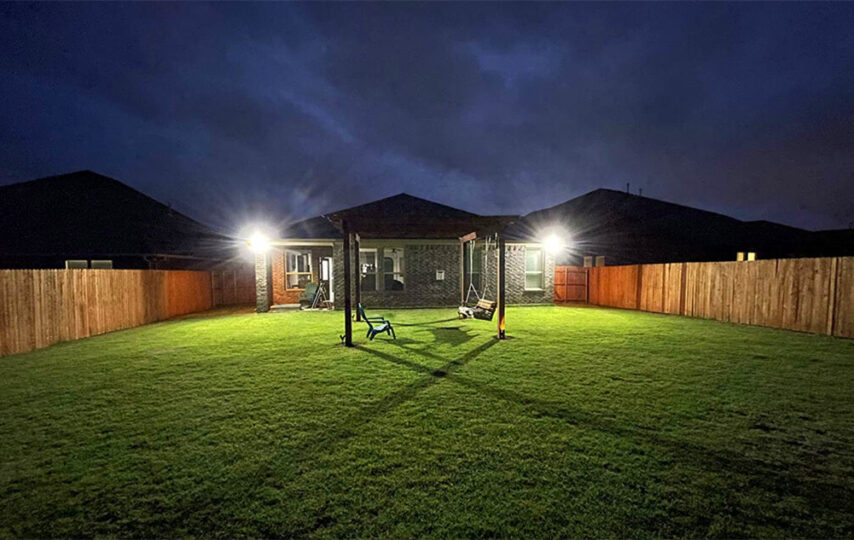

Lighting affects safety, visibility, and energy cost. That is why flood lighting matters. A good led flood light does more than brighten an area. It improves security. It lowers maintenance cost. It also reduces power consumption over time.
Market demand for LED outdoor lighting has grown fast in recent years. The reason is simple. LED fixtures deliver more usable light per watt than halogen, high-pressure sodium, and metal halide systems. Commercial property owners now replace old lighting systems because the operating cost is too high. Homeowners also upgrade because modern LED fixtures last longer and need fewer replacements.
What is a led flood light?
An led flood light is a high-output lighting fixture built to illuminate large spaces. It spreads light across a wide surface or directs light toward a focused target. The beam pattern depends on the lens design, reflector shape, and mounting angle.
These fixtures are used in residential, commercial, and industrial spaces. Common applications include driveways, building exteriors, parking areas, warehouses, sports grounds, and security zones.
Unlike traditional flood lamps, LED systems convert more electrical energy into visible light. Less energy is wasted as heat. That improves efficiency and extends fixture life.
A standard LED flood fixture includes several critical parts:
- LED chips that produce light
- A driver that controls power flow
- Heat sinks that manage temperature
- Optical lenses that shape beam spread
- Weatherproof housing for outdoor protection
Each part affects performance. If one part fails, light output drops or fixture life shortens.
Why More Property Owners Choose an led flood light
Energy cost is one of the biggest reasons buyers switch to LED lighting. Older flood lights consume more power. They also lose brightness faster.
LED technology solves both problems.
A 150-watt led flood light can often replace a 400-watt metal halide fixture in many outdoor installations. In real-world applications, this can reduce power consumption by 50% or more.
Long operating life is another reason for the switch. Traditional flood lamps may need replacement after 6,000 to 15,000 hours. Quality LED fixtures often operate between 50,000 and 100,000 hours under normal conditions.
That means fewer replacements. Lower labor cost. Less downtime.
Other performance benefits include:
- Instant full brightness
- Stable color output
- Low heat emission
- Better beam control
- Reduced voltage fluctuation issues
- Strong vibration resistance
These benefits matter in both homes and commercial properties.
Understanding Brightness Before Buying an led flood light
Many buyers still compare lighting by wattage. This leads to poor buying decisions.
Wattage measures power use. It does not measure brightness.
Brightness is measured in lumens.
Lumens show how much visible light the fixture produces.
This is the most important performance number when buying an led flood light.
Here is a practical guide:
Small Residential Areas
Use for:
- Front doors
- Pathways
- Small patios
Recommended output:
- 700 to 2,000 lumens
This level gives enough visibility without harsh glare.
Medium Outdoor Spaces
Use for:
- Garages
- Driveways
- Side yards
Recommended output:
- 2,000 to 5,000 lumens
This creates wider coverage and stronger visibility.
Commercial Spaces
Use for:
- Parking lots
- Office entrances
- Retail exteriors
Recommended output:
- 5,000 to 20,000 lumens
This supports safety and visibility in larger areas.
Industrial Areas
Use for:
- Warehouses
- Loading docks
- Storage yards
Recommended output:
- 20,000 lumens or higher
This ensures strong light over large working spaces.
Choosing correct lumen output prevents wasted energy and uneven coverage.
Beam Angle and Light Distribution
Brightness alone does not define performance.
Beam angle matters just as much.
Beam angle controls where the light goes.
A narrow beam pushes light farther. A wide beam covers more surface area.
This affects safety, efficiency, and glare control.
Narrow Beam
Typical range:
20° to 40°
Best for:
- Sign lighting
- Building accents
- Focused security zones
This sends light over longer distances.
Medium Beam
Typical range:
60° to 90°
Best for:
- Garages
- Residential walls
- Entry areas
This gives balanced coverage.
Wide Beam
Typical range:
100° to 120°
Best for:
- Parking areas
- Open yards
- Sports facilities
This spreads light over wider surfaces.
Wrong beam angles cause dark spots or wasted light.
Correct beam angles improve usable coverage.
Color Temperature Selection
Color temperature changes how a space looks at night.
It also affects visual clarity.
This value is measured in Kelvin.
Different applications need different color temperatures.
3000K
Warm white light.
Best for:
- Landscapes
- Decorative gardens
- Outdoor seating areas
This creates a softer appearance.
4000K
Neutral white light.
Best for:
- Garages
- Workshops
- Residential exteriors
This gives balanced visibility.
5000K
Daylight white light.
Best for:
- Security zones
- Commercial properties
- Industrial workspaces
This improves detail recognition.
Choosing the right temperature improves both function and appearance.
Outdoor Protection and Fixture Durability
Outdoor lighting faces tough conditions.
Rain. Dust. Heat. Moisture. Insects.
A weak fixture will fail early.
That is why protection ratings matter.
A good led flood light should have a tested weather rating.
IP65 Rating
Protects against:
- Dust entry
- Rain exposure
- Water spray
Suitable for most residential outdoor use.
IP66 Rating
Protects against:
- Heavy rain
- Strong outdoor exposure
- Commercial environments
Suitable for larger projects.
Also check housing material.
Aluminum housing performs better than low-grade plastic because it manages heat more effectively.
Better heat control means longer LED life.
Real Applications of an led flood light
Different spaces need different lighting strategies.
That is why application planning matters before buying.
Residential Use
Common areas:
- Driveways
- Backyards
- Entry gates
- Garage exteriors
Benefits:
Better visibility helps improve home security.
Commercial Use
Common areas:
- Storefronts
- Parking lots
- Hotel entrances
- Office buildings
Benefits:
Good lighting improves customer safety.
Industrial Use
Common areas:
- Warehouses
- Storage yards
- Loading areas
- Work zones
Benefits:
Stronger lighting supports night operations.
Sports and Events
Common areas:
- Outdoor courts
- Stadiums
- Open venues
Benefits:
Wide coverage supports clear visibility.
Every application needs different mounting height, beam spread, and lumen output.
Final Thoughts on led flood light
A quality led flood light is not just a lighting product. It is a long-term infrastructure investment.
The right fixture lowers energy use. It improves safety. It reduces maintenance. It performs in harsh weather.
Before buying, focus on measurable performance.
Check lumen output. Beam angle. Driver quality. Housing strength. Weather protection. Color temperature.
These factors decide long-term value.
A properly selected led flood light can deliver reliable performance for years in residential, commercial, and industrial environments.