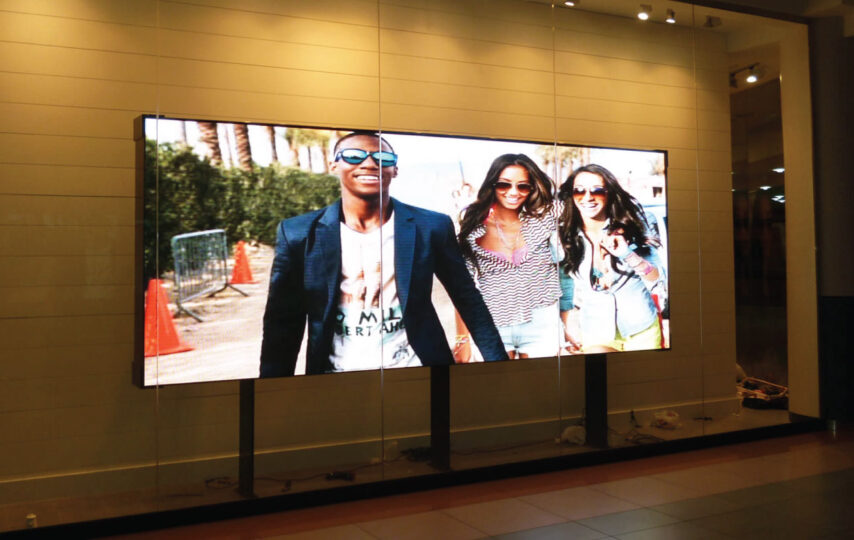

If you’re choosing an outdoor LED display screen, you’ll frequently encounter mainstream specifications like P4, P6, P8, and P10. Many purchasers are unclear about the differences between them. Today, we bring you a comprehensive, practical, and 2026 market-ready buying guide.
In outdoor LED display screen specifications, the “P” represents pixel pitch. It refers to the distance between the centers of two adjacent pixels on the screen, measured in millimeters. This seemingly simple value is a parameter that determines the screen’s performance. It affects three key indicators: screen resolution, minimum viewing distance, and cost per square meter.
The relationship between pixel pitch, display quality, and cost is a non-linear inverse relationship. This is where most buyers easily make mistakes. You might think that upgrading from P10 to P4 simply doubles the image quality, but this is not the case. Pixel density increases exponentially by the square of the pixel pitch ratio. Upgrading from P10 to P4 directly increases pixel density by 6.25 times. This explains why the price increase of high-end small-pitch screens far exceeds expectations.
Pixel Density Calculation Formula and Mainstream Parameter Comparison
We can accurately calculate screen pixel density using a common industry formula: Number of pixels per square meter = 1,000,000 ÷ (pixel pitch in mm)².
Based on this formula, we have compiled the core density parameters of four mainstream outdoor screens. Using P10 LED display screen as a benchmark, let’s visually understand the difference:
Pixels per m² = 1,000,000 ÷ (pitch mm)²
| Model | Pixel Pitch | Pixels/m² | Relative Density vs P10 |
| P4 | 4 mm | 62,500 | 6.25× |
| P6 | 6 mm | 27,778 | 2.78× |
| P8 | 8 mm | 15,625 | 1.56× |
| P10 | 10 mm | 10,000 | 1× (baseline) |
You can understand this difference more intuitively through actual scenarios: For a 20-square-meter outdoor display, the P4 screen has a total of 1.25 million pixels. However, the P10 screen with the same size only has 200,000 pixels. This 6-fold pixel difference directly determines the number of LED beads, driver ICs, and overall manufacturing costs. This is why the prices of different pitches differ so greatly.
Viewing Distance: The Core Reference Standard for Precise Selection
In the outdoor LED screen industry, we have a set of universally recognized and reliable viewing distance selection rules. It helps you avoid issues like grainy images and blurry distortion. The basic selection formula is: minimum comfortable viewing distance (meters) ≈ pixel pitch (millimeters);
if you want an extremely clear image with no visible pixels, we recommend using 3 times the pixel pitch as the optimal viewing distance.
Below, we have compiled complete viewing distance parameters for four models.
| Pixel Pitch | Minimum Distance | Optimal “No Grain” Distance | Maximum Useful Range |
| P4 | 4 m | 12 m | ~20 m |
| P6 | 6 m | 18 m | ~30 m |
| P8 | 8 m | 24 m | ~40 m |
| P10 | 10 m | 30 m | 50 m+ |
Simply apply this to your actual usage scenario—it’s simple and precise. If the closest viewing distance for viewers is 12 meters, choose a P4 or P6 screen. Both will meet the clear display requirements.
In this case, there’s no need to choose a P4; it will only increase your budget unnecessarily. Conversely, if the viewing distance is around 5 meters, choosing a P8 or P10 screen will result in noticeable pixelation. This will not only lead to extremely poor image quality but also damage your brand image.
2026 Real Market Price: Cost Breakdown of Each Screen Model
Price transparency in the outdoor LED screen industry has always been very low. Many buyers find it difficult to obtain accurate market quotes. We have combined 2026 price data for SightLED outdoor LED screens price from major Chinese LED display manufacturers. In addition, we have also provided the overall hardware cost for a standard 20 square meter project to help you with budget planning.
| Model | Price Range (USD/m²) | Typical Total Project Cost (20 m²) |
| P4 | $720 – $1,000 | $14,400 – $20,000 |
| P6 | $480 – $720 | $9,600 – $14,400 |
| P8 | $500 – $750 | $10,000 – $15,000 |
| P10 | $380 – $720 | $7,600 – $14,400 |
Important Note: The prices above only cover the cost of the screen hardware itself. When budgeting your overall project, you will need to add an additional 20%-35% to the cost. This cost covers the steel/aluminum installation structure, professional control systems such as Novartis, labor installation fees, and logistics and transportation costs.
Many people wonder why the P8 screen is more expensive than the P6 in some scenarios. This is because the cost of a screen is not solely determined by pixel pitch. Cabinet material, IP protection rating, and screen brightness parameters all significantly affect the final price. Therefore, we recommend that you verify all parameters when comparing products, and not just look at the pixel pitch alone.
Pixel Pitch Suitable Scenarios: Precisely Matching Your Project Needs
P4 Outdoor Screen: High-Definition Close-Range Exclusive
As a high-end outdoor screen with small pitch, the P4 boasts ultra-high pixel density, resulting in a delicate and grain-free image. Therefore, it is ideal for close-range, high-brand-quality display scenarios. Its best applications include high-end commercial facades, pedestrian street displays, transportation hubs, and large outdoor plaza screens.
However, be aware of potential pitfalls: If your viewing distance exceeds 15 meters, there’s absolutely no need to choose P4. At this distance, the human eye cannot perceive the high-definition advantages of P4, and the high budget spent will be wasted.
Key parameters: brightness no less than 5000 nits, IP65 or higher protection rating, die-cast aluminum cabinet.
P6 Outdoor Screen: Industry-wide Mainstream
P6 is currently the mainstream best-selling outdoor commercial display screen. It boasts 27,778 pixels per square meter, capable of outputting high-definition image quality. At viewing distances of 8-20 meters, P6 delivers clear and detailed images, fully meeting commercial display needs. Currently, most newly built commercial outdoor screens and advertising screens primarily use P6.
It is primarily suitable for scenarios such as shopping mall facades, small to medium-sized outdoor advertising screens, outdoor sports event screens, and government public notice signs. It is compatible with the vast majority of commercial projects.
Key parameters: Refresh rate ≥1920Hz, no ripples in photos and videos; common cathode design, reducing power consumption by approximately 40%, resulting in longer-term energy savings.
P8 Outdoor Screen: The Mainstay for Long-Distance Commercial Use
The P8 is the preferred model for large-scale outdoor advertising projects. It is currently the most widely implemented specification. It has a moderate pixel density and a brightness of 5000-8000 nits. The high-brightness P8 outdoor LED screen can withstand direct sunlight, ensuring stable image display. At the same time, it avoids the high premium of small-pitch screens, offering excellent cost-effectiveness.
You can use it for long-distance viewing scenarios such as street billboards, stadium perimeter screens, transportation hub screens, and building rooftop displays.
P10 Outdoor Screen: Ultimate Cost-Effectiveness
The P10 is the lowest-cost basic model among the four options. It is suitable for long-distance displays. The P10 emphasizes ultra-large display area and ultra-low construction costs. Its optimal application include highway billboards, rooftop screens in buildings over 8 stories, stadium scoreboards, and large public information boards.
There is a strict usage rule: Never use the P10 screen at close range (less than 10 meters). Close-range viewing will result in severe pixelation and blurred, distorted images.
Essential Core Parameters: Must meet local wind load standards. It is suitable for outdoor high-altitude environments; prioritize common-cathode models to significantly reduce long-term power consumption and improve overall cost-effectiveness.
5 Essential Core Parameters to Check in Engineering Procurement:
Pixel pitch is only the first step in selection. Before finalizing an order, professional engineering procurement personnel will always verify the following five key parameters. These indicators directly determine the screen’s outdoor lifespan and display performance:
1. Screen Brightness (nits/cd/m²)
The minimum brightness standard for outdoor screens is 4000 nits. This is sufficient for clear display in typical cloudy or overcast weather. If your screen faces south and is exposed to direct sunlight, or is located near the equator or in areas with strong sunlight, please choose a high-brightness screen with 6000-8000 nits. It’s important to note that you need to refer to the actual brightness of the screen at full white field, not the manufacturer’s exaggerated peak value.
2. IP Protection Rating
For typical outdoor scenarios, IP65 protection is the minimum standard. This rating can handle everyday wind and rain. However, in coastal areas with high salt spray, high humidity, or extreme rain and wind, we recommend upgrading to IP66 protection. The key difference is that IP66 can withstand high-pressure water jets. It can offer stronger protection and adapting to harsh outdoor environments.
3. Refresh Rate
A refresh rate of ≥1920Hz avoids scan lines and ripples. It can meet the needs of regular short videos and everyday shooting. For professional live streaming scenarios such as sporting events and outdoor parties, you must choose an ultra-high refresh rate screen of ≥3840Hz.
4. Grayscale Level
14-16bit grayscale processing is standard for high-quality outdoor screens. It can perfectly present gradient images and details in dark areas without color banding. Low-priced, low-end modules mostly only have 12bit grayscale. It will show obvious color banding and rough image quality when displaying delicate images such as sky gradients and skin tones.
5. Maintainability
If there is no space for operation at the back, you must choose a front-maintenance module; otherwise, for pillar-mounted or floor-standing large screens, a rear-maintenance model will meet your needs. Top China led display manufacturer’s outdoor modules support quick replacement by a single person without tools in 3 minutes. It can greatly reduce later maintenance costs and repair difficulty.
- Second Quick Selection Checklist: Precisely Match Your Project
| Your Situation | Recommended Pitch |
| Viewers within 4–8 meters (pedestrian street, retail facade) | P4 |
| Mixed audience: 8–20 meters (plaza, mall exterior) | P6 |
| Road-facing billboard, stadium perimeter (15–40 m) | P8 |
| Highway billboard, rooftop, large venue scoreboard (30 m+) | P10 |
| Budget is primary constraint, viewing ≥ 20 m | P10 or P8 |
| Content quality / brand image is primary concern | P4 or P6 |