
Selecting the right material is one of the most critical decisions engineers and project managers face when designing industrial infrastructure. Whether you are building chemical processing plants, marine desalination facilities, oil and gas pipelines, or heavy pulp and paper mills, the longevity and structural integrity of the project depend heavily on the chosen alloy.
For decades, standard austenitic and ferritic stainless steels have been the industry workhorses. However, advancements in metallurgy have brought duplex stainless steel to the forefront as a high-performance alternative.
When planning large-scale procurement and material sourcing, working with trusted distributors and fabricators such as, hnyasco ensures that project specifications are met with precise metallurgical grades.
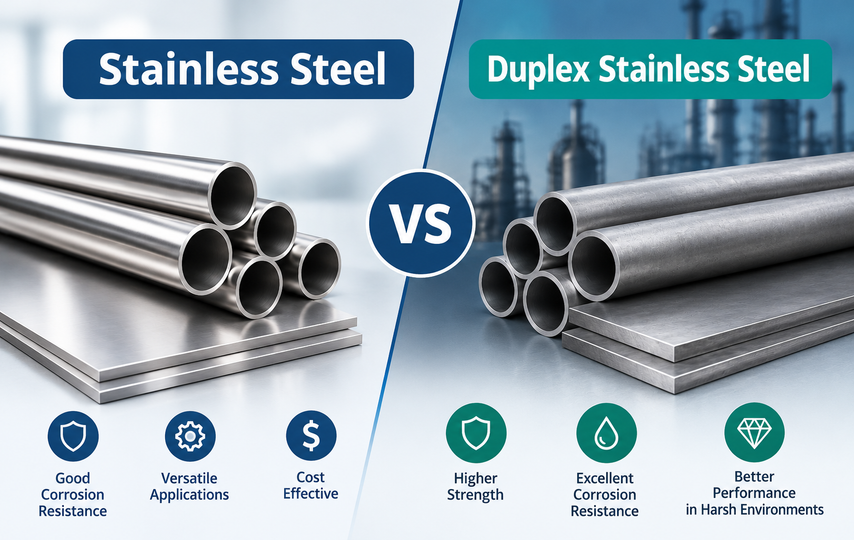
Before finalizing your bill of materials, it is vital to understand the fundamental differences between traditional stainless steel and duplex stainless steel, particularly regarding mechanical strength, corrosion resistance, fabrication characteristics, and long-term economic value.
Understanding Standard Stainless Steel
Standard stainless steel typically refers to austenitic grades (such as the widely used AISI 304 and 316) and ferritic grades. Austenitic stainless steels are characterized by their face-centered cubic crystal structure, achieved by adding significant amounts of nickel and chromium.
Key Characteristics of Standard Stainless Steel:
- Corrosion Resistance: Excellent resistance to general atmospheric corrosion and a wide range of chemical environments, especially grade 316 due to the inclusion of molybdenum.
- Formability: Highly ductile and easy to cold-form, bend, and weld without losing structural soundness.
- Non-Magnetic: Austenitic grades are generally non-magnetic in their annealed condition.
- Limitations: They have relatively low yield strength compared to carbon steels or high-strength alloy alternatives, which often requires engineers to design with thicker sections to bear heavy structural loads.
Understanding Duplex Stainless Steel
Duplex stainless steel gets its name from its dual-phase microstructure, which consists of roughly equal proportions of austenite and ferrite grains. This balanced hybrid structure combines the best attributes of both phases, resulting in an exceptional blend of high mechanical strength and superior corrosion resistance.
Key Characteristics of Duplex Stainless Steel:
- High Strength: Duplex grades possess roughly double the yield strength of standard austenitic stainless steels like 304 and 316.
- Superior Stress Corrosion Cracking (SCC) Resistance: Highly resistant to chloride-induced stress corrosion cracking, a common failure mode for standard austenitic grades in hot, saline, or marine environments.
- Magnetic Properties: Because of the ferrite phase, duplex stainless steels are magnetic.
- Cost Stability: Due to lower nickel content compared to high-nickel austenitic grades, duplex stainless steels are often less vulnerable to fluctuating market commodity prices, though their alloying elements require careful manufacturing controls.
Key Differences for Industrial Projects
To determine which material suits your specific industrial application, it is essential to compare them across four critical parameters: mechanical strength, corrosion performance, fabrication behavior, and overall project economics.
1. Mechanical Strength and Weight Reduction
The most prominent advantage of duplex stainless steel is its high yield strength. In structural engineering, higher strength translates directly to weight reduction. Because duplex steels can handle greater loads with thinner walls or smaller cross-sectional profiles, engineers can significantly reduce the total tonnage of material required for a project. This reduction not only lowers raw material procurement costs but also decreases shipping weights and simplifies on-site lifting and installation requirements.
2. Corrosion Resistance Profiles
While standard 304 and 316 stainless steels perform well in mild to moderate environments, they can struggle in aggressive industrial settings involving high temperatures, low pH levels, and concentrated chlorides.
Duplex stainless steels ranging from lean duplex grades (like 2304) to standard duplex (like 2205) and super duplex (like 2507) offer superior resistance quantified by the Pitting Resistance Equivalent Number (PREN). Higher PREN values mean greater resistance to localized pitting and crevice corrosion. For marine structures, offshore oil platforms, and chemical scrubbers, duplex grades provide a much higher safety margin against premature degradation.
3. Fabrication and Weldability
Fabrication is an area where traditional stainless steels have historically held an advantage due to their forgiving nature.
- Standard Stainless Steel: Extremely easy to weld using standard techniques without risking severe microstructural degradation. Heat-affected zones remain stable and ductile.
- Duplex Stainless Steel: Requires stricter heat input control during welding. If a weld cools too quickly or too slowly, it can disrupt the balanced 50/50 ratio of austenite and ferrite, potentially reducing corrosion resistance or toughness. Qualified welders and precise filler metals matching the duplex phase balance are mandatory for successful fabrication.
4. Life-Cycle Economics
Evaluating cost solely on initial purchase price can be misleading. While standard stainless steel may offer a lower upfront material cost, its limitations in harsh environments can lead to frequent maintenance, unexpected downtime, and premature replacement.
Conversely, duplex stainless steel offers a superior life-cycle cost profile. The initial material savings from down-gauging (using thinner sections) combined with extended service intervals and zero maintenance downtime often result in a much lower Total Cost of Ownership (TCO) over the lifespan of an industrial asset.
Application Guide: When to Choose Which?
Choosing between standard and duplex stainless steel depends entirely on operating conditions and project demands:
Opt for Standard Stainless Steel (304/316) When:
- The application involves food processing, pharmaceutical manufacturing, architectural facades, or indoor chemical storage where chloride levels are low.
- Fabrication simplicity and standard welding procedures are top priorities for local workshops.
- Initial capital budget is strictly constrained, and operating conditions are mild.
Opt for Duplex Stainless Steel (2205/2507) When:
- Your project involves marine environments, desalination plants, subsea pipelines, or chemical processing units exposed to high chlorides and elevated temperatures.
- Structural weight reduction is critical, such as in offshore platforms or large storage tanks.
- Long-term durability and resistance to stress corrosion cracking are required to eliminate costly maintenance shutdowns.
Conclusion
Both standard stainless steel and duplex stainless steel play vital roles in modern industrial engineering. Standard grades remain the reliable choice for general-purpose applications requiring excellent formability and moderate corrosion resistance. However, for demanding industrial environments where high mechanical strength, resistance to stress corrosion cracking, and long-term durability are non-negotiable, duplex stainless steel delivers unmatched performance. By carefully evaluating your project’s mechanical requirements, environmental exposure, and life-cycle economics, you can select the optimal alloy to ensure safe, efficient, and cost-effective operations for decades to come.